Event techniques#
RPG Maker's events have no variables, no sums, no way to read the controller and nothing that runs by itself. Makers built a piano, a battle system and a fighting game anyway, and this study added a puzzle and three self-running demos. Every one of them stands on a handful of tricks, and every trick comes from how the program picks pages and runs commands. This page takes nine systems apart so that you can reuse what's inside them. The commands themselves are explained on Events.
Four rules carry everything on this page:
- An event has no "if", but its pages do. The program walks an event's pages from the highest down and runs the first whose conditions all pass: switches, items held or not held, Gold. A later page therefore beats an earlier one.
- A page after page 1 with no conditions is never picked. Only a Take Over reaches it, so it works as a private subroutine.
- Pages are picked again only at set moments: when an event ends, after a battle, after the field menu and on arrival on a map. Not in the middle of an event.
- A Take Over shows its target page's look at once: graphic, colour, Ghost and facing, on the event and on every one of its Duplicates.
Reading the pad: the parked party#
No command reads the controller. What the player can do is walk, bump into things and press ×. So the oldest answer, already in THE EVENT OF TODAY around 2001 and used again by Arc Arath and Generic Quest VIII, is to stop the party from walking and put an event wherever it would go.
- Park the party on a tile it can't leave. Hide it with Party Display, or leave it off-screen and move the view with Shift Screen, as the piano does.
- The d-pad is four events. Invisible (No Graphic) events on the tiles around the party start on Touch. A press bumps one and runs it, and the party stays where it is.
- × is an event under the party. × checks the party's own tile first and the faced tile second, so a Check event standing on the party's tile answers it.
- Every press is one event run. When the run ends every page is picked again, so whatever shows the state (a lit key, an HP bar) catches up by itself.
Three more tricks grow out of the same rig:
- One event, two buttons. A page is chosen by its conditions; only then does its start method decide what can start it. A d-pad event whose chosen page starts on Check does nothing when bumped, but the bump turns the party to face it, and × then reaches it as the faced tile. THE EVENT OF TODAY uses this for menus with more than four buttons; Be Instructive builds its whole control scheme on it.
- Moving an event under the party changes what × does. Move to Point ignores collisions, so any event can be walked onto the party's tile, and × then starts that one. The tile works like a function pointer.
- Several parking spots. THE EVENT OF TODAY's battle maps have four stations (battle, technique menu, skill equip, character skills) and move the hidden party between them with Move Party. Neighbouring stations share their edge events, and since the view follows the party, each move also brings the right menu on screen.
A piano from switches (Arc Arath)#
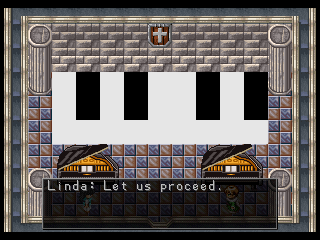
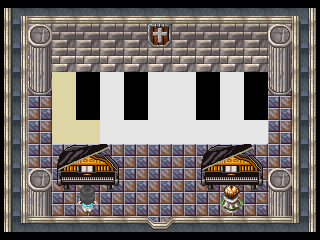
In Arc Arath's church a wall-sized keyboard of nine keys hangs over a grand piano. Linda offers How to play, Try out Free Play and Play for real. In Free Play ← and → move a highlight across the keys (it wraps at both ends), × plays the lit key and ↓ asks whether to stop. Playing for real, the piano plays each of three songs by itself, lighting each key as it sounds, and then you repeat it; a wrong key sounds a buzzer. All three songs earn 1,000 gold and a random Affinity Fragment, as often as you like.
It is 21 events, 18 Duplicates and 359 pages on one map. The party is parked off-screen, and the Intro Event moves the view 8 tiles to the left so that the keyboard shows and the party doesn't.
The cursor is nine switches#
Exactly one of switches 1–9 is on, and that switch is the cursor. No page has to compare anything: page priority finds the one page whose switch is on, and when the event ends every key re-picks its own page and the highlight moves by itself. × lands on an event under the party whose nine pages each play one key.
Every other pitch step#
Every key plays sound 73 with Sound Effect + Pitch, on pitch steps 2, 4, … 18. The 19 steps aren't evenly spaced semitones, so the keys aren't the chromatic run they look like:
| Key | 1 | 2 | 3 | 4 | 5 | 6 | 7 | 8 | 9 |
|---|---|---|---|---|---|---|---|---|---|
| Pitch step | 2 | 4 | 6 | 8 | 10 | 12 | 14 | 16 | 18 |
| Semitones | −16 | −12 | −9 | −5 | −2 | +2 | +5 | +8 | +12 |
The gaps between neighbours are 4 3 4 3 4 3 3 4 semitones: a stack of thirds, which together give the notes of F♯ Lydian. Any run of keys sounds consonant. The buzzer is sound 3 .
The demo is a chain of pages#
The piano's own playing is a chain of pages with no conditions on the key events. Each one is: play the note, wait, blank the key with Change Event Graphic, Take Over the next key's page. The Take Over lights the next key for free: it shows the target page's graphic on the key and on all its Duplicates. A key that sounds several times in a song needs one page per time, because each page names its successor; key 6 has seven. The last note of each demo Takes Over the "play it again?" menu.
Checking the song: a table under your feet#
"I'll give it a shot" moves the note-playing event off the party's tile and moves the song's checker onto it, so that × now runs the checker. Setting this up takes about 70 frames.
- A checker has one page per (note, key) pair, with two conditions: the key's switch and the note's stage switch. The right key plays and turns on the next stage switch; a wrong one plays, waits, buzzes and returns to the menu.
- Old stage switches are never turned off. Later stages have higher pages, and the highest page that passes wins, so the newest stage always beats the older ones. Song 1 uses stage switches 11–20, song 2 21–29, song 3 30–38.
- The three checkers have 90, 83 and 82 pages. 90 is the editor's limit.
Restart by moving into the same room#
Move Location to the room you're in is the piano's "restart with a new state". It puts every event back on its home tile and first page, keeps the switches, and runs the Intro Event again. The Intro's pages are a dispatch table: a page for switch 39 (the reward), 30 (song 3's demo), 21 (song 2's), 11 (song 1's), and page 1 for a fresh start. "Play it one more time", every new song and leaving Free Play all go through it. The view's shift survives the move.
A battle system from items (Generic Quest VIII)#
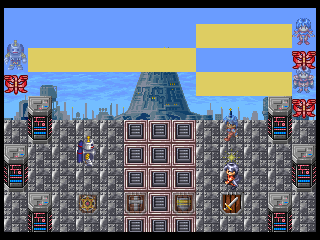
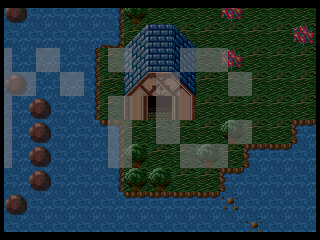
Generic Quest VIII is a short joke RPG from 2011 whose point is its custom battle system: HP bars, MP, spells and elements, items, defending, fleeing, ambushes and an enemy that thinks, all in event commands. The stock battle system is never used. Its first scenario holds 23 maps, 283 events, 1,564 pages and 22,399 commands, of them 5,869 Remove Item and 3,141 Take Over. Each of the five enemy types has a battle map of its own with a whole copy of the system (about 44 events and 415 pages), and these maps are three quarters of the scenario's event data.
Every number is an item#
The game keeps its state in items with plain names, so the field menu's item list doubles as a debugger.
| State | How it's kept |
|---|---|
| A hero's HP | Three items, P1 HP 2, 3 and 4: HP is 1 + the number held. A page tests one boundary: "holds P1 HP 3, doesn't hold P1 HP 4" is exactly HP 3. |
| The foe's HP | Foe HP 7 down to Foe HP 2, the same way |
| MP | a count, 0–6 copies of one item |
| Whose turn | one token item each: P1 Turn, P2 Turn, Foe Turn |
| Defending | P1 Defend, P2 Defend |
| The menus | switches 1–4 the command cursor, 5–12 the item targets |
- Damage is "remove the top item". Nothing can subtract, so every action that depends on a value has one page per value. Tony's attack has a page for each foe HP, with and without MP, with Lucia alive and dead: 28 of his 52 menu pages.
- Overcasting. A spell page asks only "holds P1 MP", and Remove Item stops at 0, so a 3-MP spell can still be cast with 1 MP left. The game's FAQ presents it as a feature.
- Healing removes before it adds: −HP 3, −HP 2, +HP 2, +HP 3, +HP 4. That way no item ends up with two copies, which would make the next hit invisible.
- An HP bar is a row of square tiles, each with a dark page "doesn't hold Foe HP n". As the items go, the bar empties itself.
Turns: the actors walk onto your tile#
The party is parked as above: ← and → move the command cursor, ↑ and ↓ the item target. The menus aren't opened by the player. Each actor is an event that walks onto the party's tile when its turn begins, so × runs the page that matches the state: Tony's menu (52 pages), Lucia's (38) or the enemy's (81). An action changes the items, sends the actor home and Takes Over an animation, and the animation ends by Taking Over the next actor's first page. Skipping a dead hero is just a choice of animation page.
- The enemy's 81 pages are every state its AI can meet: each hero's HP or death, and who is defending. Each page holds the whole turn as a tree of Probability commands (melee or magic, which target, hit, critical or miss at 60 / 20 / 20 %), every leaf already knowing which item to take.
- A page number can carry a value. The battle's Intro Event has 16 pages, one per pair of HP values. On an ambush (20 %) it Takes Over the same-numbered page of the ambush event, which therefore knows the HP without testing it.
- A router map brings the party home. Each monster on the field sets its own switch when touched. Every battle ends on a black map whose Intro Event has a page per monster switch, each moving the party back to that monster's spot. The same switch hides the beaten monster, and leaving the area clears the range, which brings the monsters back.
Staircases, Gold and release detection (THE EVENT OF TODAY)#
Four ways to keep a number in items#
| Kind | Example | What it costs |
|---|---|---|
| A count | a timer of 26 copies of one item, −1 a tick; "holds none" means time's up | one condition tests only zero or not |
| One item per level | Generic Quest VIII's HP | one page per value for every change |
| A staircase | battle HP in ten items: item j holds max(0, HP + j − 10) | damage is one fixed list of ten Remove Items, whatever the HP |
| Reset to N | remove 16, then add 16: exactly 16 whatever was left | relies on Remove Item stopping at 0 |
The staircase is the heart of THE EVENT OF TODAY's battles. Generic Quest VIII needs one page per HP value for every hit; here a hit is one fixed list, and because Remove Item at 0 does nothing, the shape stays exact as the items run out. The same layout gives each HP-bar tile its condition. Healing is the expensive direction: one page per current HP. A boss's three-item power gauge (counts 2, 4 and 6) uses the same idea and stops at 6 by itself.
Gold as a register#
Gold is the only number a condition can compare (Gold more than / less than), so the game uses it as a register:
- Set it to 0 with Gold −900,000: Gold can't go below 0. Set it to 6 with −990,000 and then +6.
- A free upper limit. A gauge is stored upside down, Gold = 6 − the gauge. Gaining a point is Gold −1, so the stop at 0 becomes a cap at 6.
- Displays are page ladders: 21 events, each with a page "Gold more than n", draw a score column.
- Gold is off outside the mini-games. Gold conditions always fail while the Game System's Gold option is off. Every mini-game turns it on, zeroes it and uses it, and every exit turns it off again. Gold off also hides Gold in the field menu and doubles as the opening scene's "already seen" flag. Money is a set of items, bought and spent through the Trade Shop, which never asks about Gold.
Take Over as the instruction set#
| Use | What it does |
|---|---|
| Goto | the last command of a page jumps on: every mini-game's tick ends this way |
| Subroutine | a page that nothing can start, called from several places |
| Sprite setter | the battle hero has pages 5–80, one per pose and facing; Taking Over a page shows that pose |
| Animation frame | an HP bar drains as a chain of hops, each re-arming one tile to its dark page |
| Parameter | the same chain three times, one per "who acts next": the page number carries the value |
Overlapping events: hearing the button let go#
The game's readme speaks of "overlapping events". They turn out to be a way to tell whether a direction is held or released, which the program can't otherwise know.
- The input event walks off when you let go. At the moment a release should count, the event next to the parked party gets a page whose Move Type is Away. While the direction is held it is bumped again on every frame, an event is always running, and nothing moves while an event runs. Once the button is up, the event steps away on its next movement turn onto an empty tile the designer left for it.
- A second event waits underneath. The Intro Event places it on the same tile with Move to Point, which ignores collisions. Only one event per tile is tried, the one that has stood there longest, so the top event takes every press until it walks off. After that the next press reaches the one underneath.
- The window is random to the player. Events take their movement turns in rotation, so the step comes 1 to N frames after the last frame the button was seen, where N is the map's number of objects, at most 40. Measured on the race game: the allowance was anything from 0 to 39 frames, depending on everything played before. The slot machine's sign says a reel sometimes keeps turning if you press again quickly, and that is exactly right.
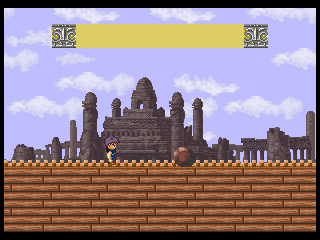
The punch game, the knock-down game, the race, the spinning game and the slot machine all use it.
A combo parser (Be Instructive)#
Be Instructive is an RPG Tsukuru 3 fighting game by the maker of THE EVENT OF TODAY: a one-on-one ring of seven cells, ring-outs, a super gauge and fighting-game command inputs. Every fight map has the parked party in the middle of four d-pad events with 66–88 pages each. The fighters' positions are one-hot switches, and each fighter's HP is an item staircase.
- "→ and ×" is "face →, then ×". In an attack or defence turn the d-pad events' chosen pages mostly start on Check. A bump on a Check page starts nothing, so → only turns the party; × then checks the faced tile, which is the → event. Holding isn't needed. Moving and attacking are told apart by which page is chosen.
- The parser is a set of switches, each one a partial match. A turn begins by switching on the starting set. Each d-pad event has one Touch page per active switch, placed above its movement pages, so a direction that continues a match runs the parser instead of moving.
- The last direction and × is a Check page keyed on the final switch, the move's "learned" switch, and the gauge items.
| Special | Input (the US program's ×) | Gauge |
|---|---|---|
| Omega Attack | → ↓ ↑ + × | level 2 |
| Hyper Crash | → ← ↓ + × | level 1 |
| ULT Cyclone | (↑) + × × ← + × | level 3 |
| Goodbye Guard (defence) | ← → + × | none |
| Head Bomber (defence) | ↑ ↓ + × | level 1 |
Mashing is forgiving. Once a finishing page is chosen on a d-pad event, pressing that direction again only turns the party, and most presses that don't continue a match land on Check pages and change nothing. So → ↓ ↓ ↑ × still gives Omega Attack. The (↑) in ULT Cyclone is in brackets because every turn already starts with the party facing up.
Lights Out from its rule (Brazier Hall)#
Brazier Hall was built for this study to see whether a system designed from the decoded rules works the first time. It is the Lights Out puzzle: touch a brazier (× while facing it) and it flips, lit to cold or cold to lit, along with its four neighbours. Light all 25 and the door opens onto a chest. A Keeper explains the rule and lays out a new pattern on request.
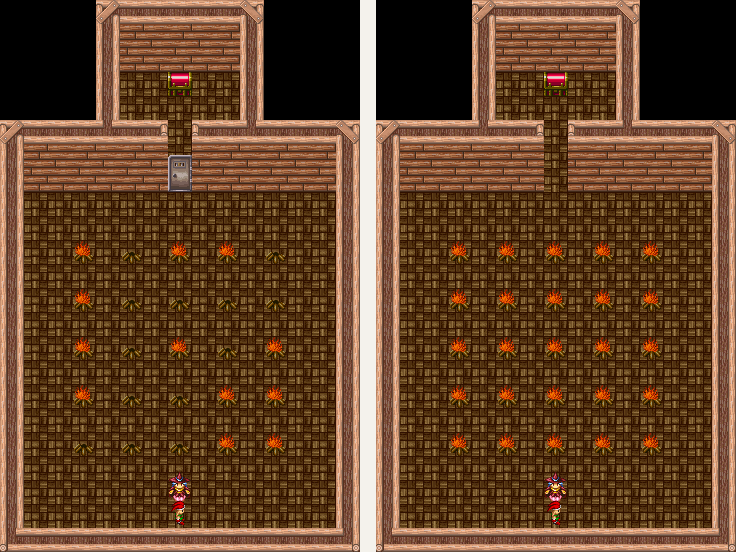
- One page per state. Each brazier has a page for every lit / cold combination of the braziers it flips, so exactly one passes. Its contents turn each of them off or on. Page 1 can't have conditions, so it takes the all-cold case. Five conditions fit within the editor's limit of six. The page's graphic is the brazier's own state: Object 17 (a burning campfire) or Object 16 (cold). When the event ends, all five braziers re-pick their pages and redraw.
- A counter instead of 25 conditions. The door should open when all 25 burn, but a page holds six conditions. So an item, "Cold Brazier", counts the cold ones: each touch page knows how many it lights and puts out, and removes or adds that many. The door's open page needs one condition, "doesn't hold Cold Brazier". The count is in the item menu too.
- Patterns are chosen ahead of time. Not every Lights Out board can be solved. The eight patterns were picked offline, each with its best number of touches (4 to 9). A hidden event deals one: a page with no conditions, reached by Take Over, sets all braziers lit, removes 25 Cold Braziers (any extra Remove does nothing), and picks a pattern with three levels of 50 % Probability. Each leaf says "Pattern n of 8. It takes p touches at best."
- The first pattern is dealt by the Intro Event, whose one page needs a switch off and Takes Over the dealer; the dealer turns the switch on.
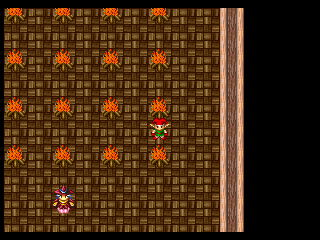
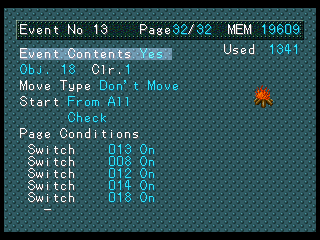
The hall is one map: 30 events, 522 pages, a block of 21,057 bytes of the map's 40,666. It was checked three ways: every brazier in every local state; the whole state space of a 3 × 3 version (276,548 states), which also caught six deliberate slips of the kind Generic Quest VIII has; and 193 inputs played in an emulator with no difference from the model.
A demo that runs by itself (Take Over)#
Nothing in RPG Maker runs on its own. An event starts when the player touches or checks it, or when a map's Intro Event runs on arrival; while one runs, nothing else on the map moves; and no event can branch on the game's state. Take Over is a two-minute demo built for this study that needs all three anyway: a scroller, a spiral, a tunnel, 48 dancers, a plasma, fireworks and an end scroller, every change on the beat of the music, with nobody pressing anything.
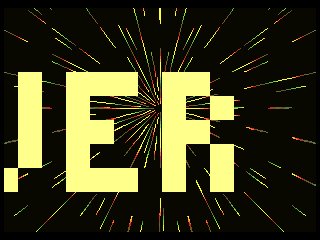
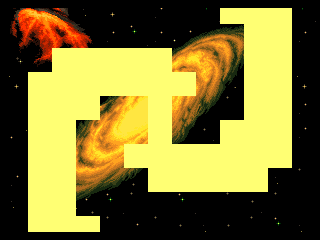
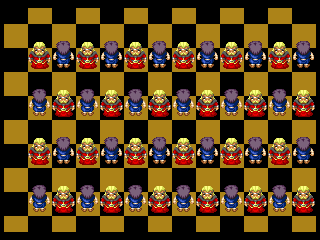
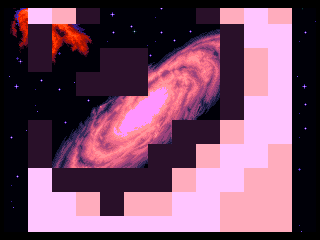
The whole demo is a single event thread that never stops. Every page ends with a Take Over of the next page, or with a Move Location whose map's Intro Event Takes Over the next part. The last part goes back to the title. A loop is 1,619 commands, 695 of them Take Overs, and lasts 7,320 frames (2 minutes 2 seconds).
Every command on a known frame#
Because the thread is the only thing running, every change happens on a frame that can be worked out in advance. These are the costs measured in an emulator and used by the demos:
| Command | Frames it takes | Measured in |
|---|---|---|
| Any command | at least 1 | Take Over, Key On |
| Take Over | 2 | Take Over |
| Wait t (tenths of a second) | 6 × t | Take Over |
| Wait 0 | 1 (does nothing else: the padding for an exact frame) | Take Over |
| Sound Effect (+ Pitch) | 2 | Key On |
| Move Party, n tiles | 12 × n + 1 (13 for one tile) | Take Over, Key On |
| Turn (one spin) | 22 | Key On |
| Effect | the animation's own frames + 6 | Take Over |
| Message 1, n lines | 95 × (n − 1) + 772 | Take Over |
| Move Location | 171, from its first frame to the new map's first command | Take Over, Page Flip |
| The refresh command (not in Event Edit) | 1 | Page Flip |
A beat of the music (BATTLE 1, 126 beats a minute) is about 28.6 frames. Waits and Wait 0 pad the thread so that each command starts on exactly the frame it should. In the emulator, 1,066 of 1,066 traced commands ended on the frame the timing predicted.
- The music has to survive Move Location. Change BGM marks the song as set by an event, but Move Location clears that mark, so every arrival plays the map's own BGM. Every map but the title has BGM 1, which is already playing and carries on; the title has none, so each loop restarts the song in step with the pictures.
- Colour cycling. The spiral, the tunnel and the plasma are 11 × 10 fields of plain square tiles (object 38: white, dark, transparent or gold). Tiles with the same phase form a layer, one Event with Duplicates on the rest. A Take Over re-arms the layer's page, which recolours every tile of it in one 2-frame command: a palette. A step that changes two layers costs two Take Overs, 4 frames, so the whole screen can move 15 steps a second.
- Parallax. The title's letters are painted into the map, the hidden party walks right and the view follows, while the map's wallpaper stays fixed on screen.
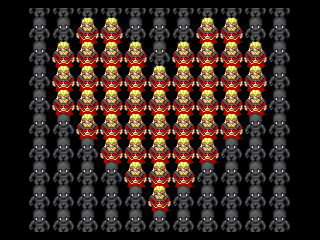
- The dance. Event Direction, the turns, Change Event Graphic and Move Event act on an event and all its Duplicates in the same frame, so each crowd of 24 moves as one.
- Fireworks. An Effect plays at the running event's position, so Taking Over a layer event first moves the launch point.
Music from sound effects (Key On)#
Key On has no background music. Its two-minute soundtrack is an original song in which every note is a Sound Effect command in the thread, and the pictures are what the thread does between the notes. It ends in the game's own Ending, whose credits run over snapshots the demo took of itself.
- The 19 pitch steps are a scale. Sound Effect + Pitch offers 19 steps: −17 −16 −14 −12 −10 −9 −7 −5 −4 −2 0 +2 +3 +5 +7 +8 +10 +12 +14 semitones. That is a natural minor scale on the sound's own pitch, two and a half octaves of it.
- A note every other frame. The command takes 2 frames, and each sound rings on its own voice for its sample's length (24 voices are shared).
- On the thread's clock. A note that is a command lands on the frame the thread is on, so sound and picture can't drift apart.
Of the 78 sounds, these hold a pitch well enough to play, and they are in tune with each other:
| Part | Sound | At step 10 | |
|---|---|---|---|
| Bass | 44 | A2 | |
| Lead | 28 | D | |
| Keys | 73 | E3 (the church piano's tone) | |
| Ping | 4 | C5 | |
| Chime | 77 | C | |
| Kick, snare, hat | 68, 47, 62 | drums |
Each sound's scale sits on its own root, which decides the key: the bass has all of A minor, so the song is in A minor, on Am, F, C and G.
The three scenes each find a different use for the free slots:
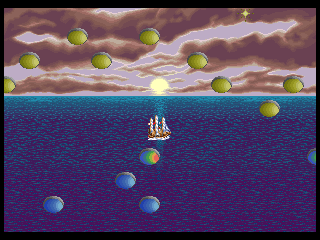
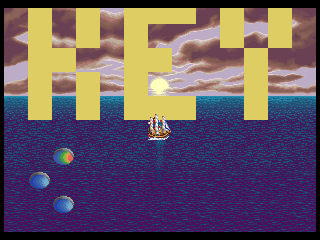
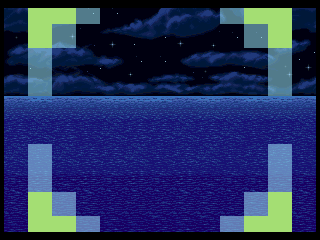
- Dusk: the map is the sheet music. The party is one member drawn as a ship, sailing over a sunset sea that is the fixed wallpaper. An orb hangs in the sky for every note of the tune, at the height of its pitch. The thread plays a note, then walks the ship one tile (13 frames), so each orb sounds as the ship passes under it.
- Night: ripples. 110 squares form 8 rings, each ring an Event with Duplicates; each step of a ripple is two Take Overs, the next ring on and the last one off.
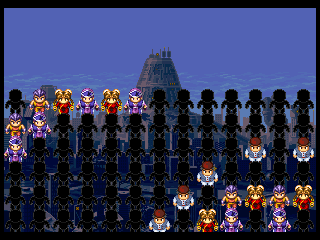
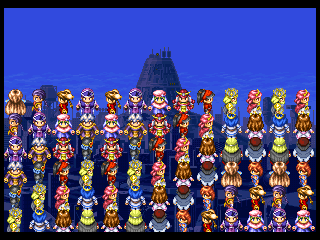
- City: a crowd. 78 people in 16 layers start as the black shadow figure (character 34). A band of light crosses them: a hop shows a layer in its costume, facing you. In the break, one hit a beat and a layer spins once (Turn, 22 frames): hit 6 frames, tint or snare 2, Take Over 2, Turn 22, a beat exactly.
- The Ending never returns, which is how the demo stops. Four Snapshots taken on the way play behind the credits; the snapshot area holds 4,888 bytes at 24 a sprite, which is why there are only four.
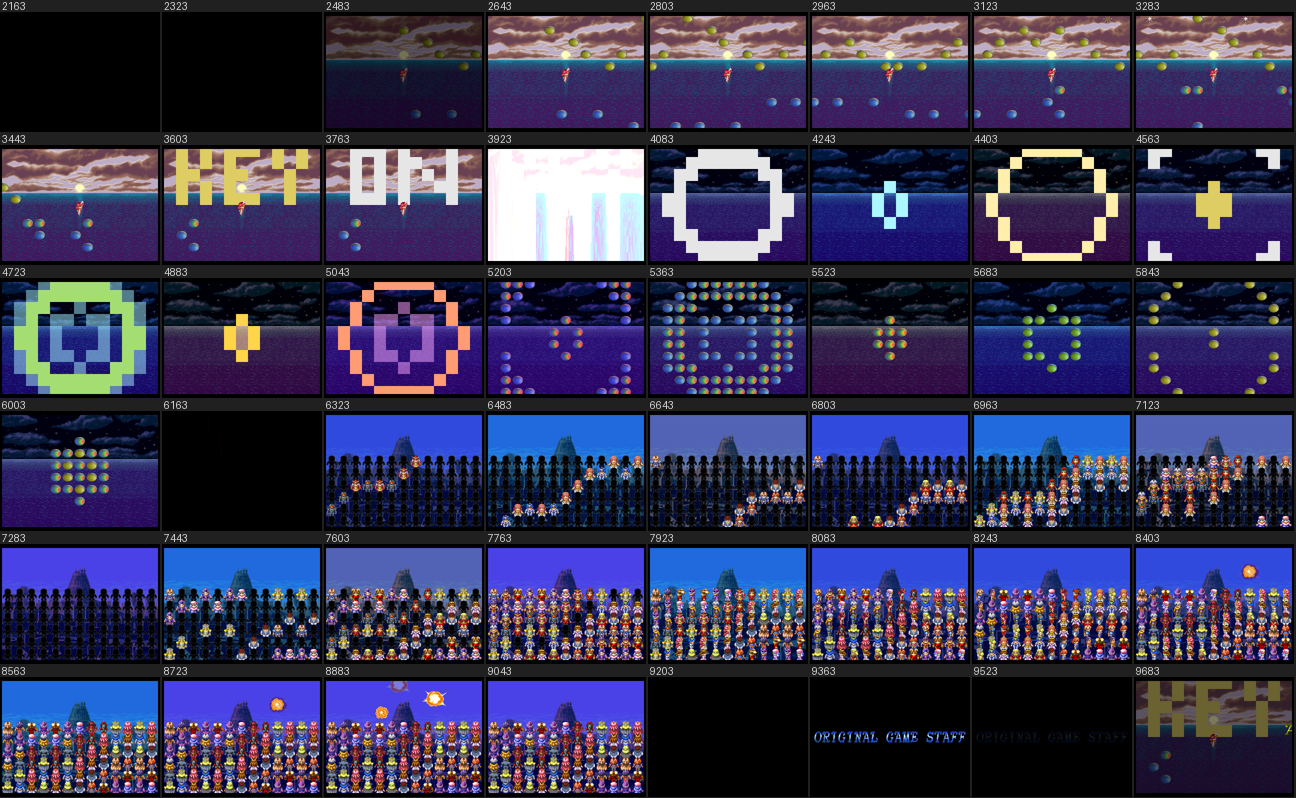
Key On is 302 events and Duplicates, 1,006 pages and 2,522 commands, 802 of them notes and 963 Take Overs: 6,715 frames from the first command to the Ending.
Two gaps past the editor#
Event Edit only offers switches 1 to 500, and a few commands the program understands are never offered at all. Neither limit is checked when the game runs, so a Scenario written by a tool (not typed in Event Edit) plays them on an ordinary console. No fan game in the archive uses either.
- Switches past 500 write the game's state. Switch On, Off and the ranges take any number, and a switch is just a bit, so a number past the 500 switches reaches whatever is stored after them. As the program counts them (from 0; Event Edit shows each one higher): treasure flags 504–759; the bag count of item i at 792 + 8i to 799 + 8i; Gold 4816–4847; the view's offset 4912–4943; the party's display 6432–6439. Switch On 4820 turns Gold 0 into 16; a range turned off clears an item's count in one frame. A count written this way isn't listed in the bag, and the usual limits (99 an item, 999,999 Gold) don't apply.
- A page condition can test these bits too, up to number 4,095: every bag count, bit by bit. Gold is out of its reach.
- The refresh command picks every event's page again, in 1 frame, in the middle of a running event. Normally pages are only picked again when an event ends.
The details are on Limits and How it works.
A frame buffer of event pages (Page Flip)#
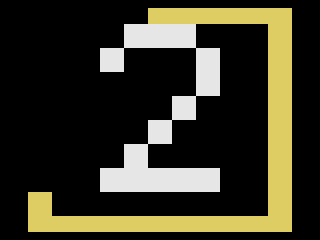
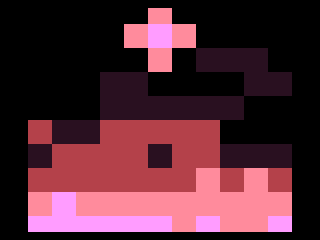
Take Over and Key On change one layer of Duplicates per Take Over. Page Flip gives every "pixel" of the screen a timeline of its own, so it can show any picture: a letter scroller, fire, a bouncing ball, a plasma, Conway's Life, a crowd holding up pictures.
- 110 square events cover the screen, 11 × 10. Each page after the first means "this look while Gold is at least a and less than b": two ordinary Gold conditions.
- A picture is two 1-frame commands: Gold + n, then the refresh. Gold is the frame number of a film stored in the pages.
- Overlap is free. The highest page that passes wins, so a gold interval may sit inside a white one.
- Looks. The square's white, dark, transparent and gold, each also in Ghost, give a ramp of five over a black map: black, dark, dim gold, gold, white. The map tint recolours the whole ramp in 2 frames.
What a picture costs. The refresh walks each event's pages from the highest down and stops at the first that passes, so what counts is the pages visited. In the emulator a frame held while the visits plus 6.5 for every object whose look changes stayed under about 2,000; the demo keeps every refresh under 1,500. Three consequences shaped the demo:
- Duplicates take their original's page without a walk, so a four-fold symmetric picture needs 30 events and 80 Duplicates: about a quarter of the cost.
- A clip's first picture costs the whole clip, because the walk passes every later page. A map holds about a thousand pages of film. Sparse pictures cost more than busy ones, since a resting pixel walks all its pages.
- The ball is a sprite on switches, not part of the film: its picture k shows while switches 10 to 10 + k are on and the next one is off. So it moves separately from the fire, even backwards while the fire burns on.
The thread is a projectionist. The film isn't played once from end to end; the thread moves the counter the way a DJ moves a record:
| Move | Commands |
|---|---|
| Play | Gold +1, refresh |
| Fast, slow | Gold +2; a Wait before the refresh |
| Reverse | Gold −1, refresh |
| Loop | Gold −N at the clip's end |
| Jump cut | Gold ± k to another clip |
| Scratch | +1 +1 −2 +1 +1 −2 on the 16th notes |
The music is Key On's method, and a picture takes a 2-frame slot just like a note, so each row of the song is shared between the band and the projector.
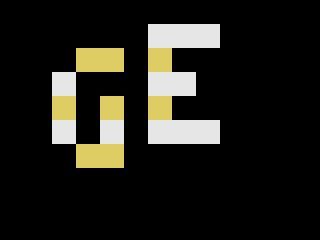
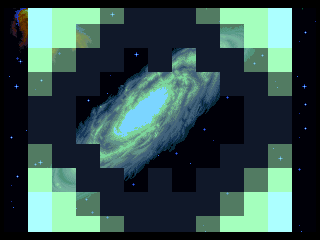
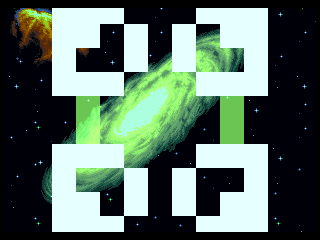
Page Flip is four maps and a 56-bar song, 119.5 seconds a loop: 5,748 commands, 670 notes and 1,262 pictures. In Test Play in an emulator, all 1,272 refreshes of the run landed in their frame, and after each one every event showed the look the film asked for. A transition between maps is a Move Location of 171 frames, written into the song as a two-bar break.
The toolkit#
| The engine has no… | The answer | Where it's used |
|---|---|---|
| way to read the pad | the parked party: Touch events round it, a Check event under it | the piano, Generic Quest VIII, THE EVENT OF TODAY, Be Instructive |
| variables | switches (one on at a time), items (a count, one item per level, a staircase), Gold | everywhere |
if on a value | page conditions: the highest page that passes is the one that runs | everywhere |
| arithmetic | one page per value; on a staircase, one fixed list of Remove Items | Generic Quest VIII, THE EVENT OF TODAY |
| subroutines, jumps | Take Over to a page with no conditions, which nothing else can start | everywhere |
| branch on the state inside an event | Move Location to the same map: its Intro Event's pages pick what comes next | the piano, Generic Quest VIII |
| choice of what × does | move a different event onto the party's tile | the piano, Generic Quest VIII |
| button release | two events on one tile, the top one with an Away Move Type | THE EVENT OF TODAY |
| combo input | a set of switches, each a partial match, moved on by Touch pages | Be Instructive |
| anything that runs by itself | one endless Take Over thread, handed from map to map by Intro Events | Take Over, Key On, Page Flip |
| timer | the frame cost of every command, padded with Wait and Wait 0 | Take Over, Key On, Page Flip |
| music editor | Sound Effect + Pitch, one note per 2-frame slot | Key On, Page Flip |
| frame buffer | Duplicates recoloured by Take Over; or Gold intervals and the refresh command | Take Over; Page Flip |