Limits, bugs and workarounds#
One place for "why doesn't this work?". This page lists every hard number a maker meets in RPG Maker, how a full-size game spends them, the bugs the study found, sorted by where they bite, and what the program can't do, with the ways round it. All of it comes from reading the program and from runs in the PCSX-Redux emulator: two probe games built to fill every limit at once ran through the real engine without a hitch.
The limits#
The System and the scenarios#
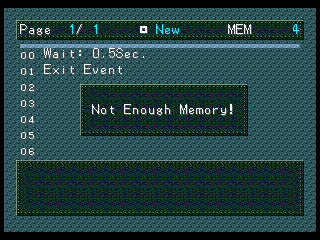
A game is one System and any number of Scenarios, and each is a fixed block of memory while you edit it. Every editor's MEM counter is what is left in its block (Getting started).
| What | Limit | Notes |
|---|---|---|
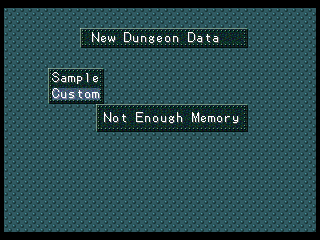
| The System (one per game) | 122,368 bytes | Every database, every map of the game, Monster Appearance, the settings. The MEM counter of each System editor is what is left of it. |
| A Scenario | 122,368 bytes, of which 120,276 for events | Every event of every map in that scenario. A new, empty scenario shows MEM 120,255. |
| One map's events | 40,666 bytes | The map's Intro Event, Events, Treasures and Duplicates together, so one event is at most that too. Event Edit's MEM is the smaller of this and the scenario's room. |
| A save of either | 15 blocks, a whole card | A full image is exactly 15 blocks, even stored uncompressed. Smaller ones compress, text least of all. |
The System is the game-wide budget, and the maps are most of it. Every dungeon map and field map of the whole game shares those 122,368 bytes with the databases. A scenario only holds events, and what fills a scenario is text: messages and choices are nearly all of it.
The database#
| Database | Most | Bytes each | Notes |
|---|---|---|---|
| Magic (Magic and S ATK together) | 230 | 40 | |
| Items | 250 | 24 | Up to 99 of each in the bag. |
| Characters | 15 | 260 | Up to 4 in the party. |
| Skills | 15 | 52 | One per character; 8 S ATKs each, Level +0 to +7. |
| Monsters | 250 | 52 | 8 attack patterns, 7 abilities, 1 treasure each. |
| Parameter Names | 22 | 6 each | Names of 6 characters, used across the game. |
Maps#
| What | Limit | Notes |
|---|---|---|
| Dungeon maps | numbers 1–990 | In the System, sharing its bytes with everything else. |
| A Custom map | 65 × 65 tiles, two layers | 32 bytes plus its layers: each layer costs either every cell of its bounding box, or 3 bytes a part, whichever is smaller. |
| A Sample map | 19 bytes | One of the disc's ready-made layouts of its map set, used as it is. |
| Map sets | 249 | On the disc; no tileset of your own (Map sets and tiles). |
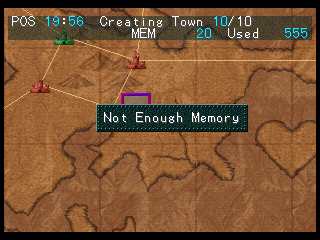
| Field maps | 8 | Each 64 × 64 tiles, laid in 16 × 16 parts. 275 bytes each, plus 21 a town and 7 a path. |
| Towns, paths | 30 towns, 99 paths a field map | A town can't be moved: it has to be deleted and made again, paths and all. |
| Monster Appearance | 255 areas a map, 8 monster slots an area | 2 bytes a map plus 13 an area. |
Events#
| What | Limit | Notes |
|---|---|---|
| Events on a map | 120 | Events, Treasures and Duplicates together; numbered 0–119, the lowest free number reused. |
| Intro Events | 1 a map | |
| Pages | 90 an event | |
| Conditions | 6 a page | None on page 1. |
| Switches | 500, for the whole game | Kept by Next Scenario. |
| Treasure Events | 256 a scenario | One treasure flag each; Next Scenario clears them. |
| Moving events | 40 move each frame | From the 41st on, events share movement turns with the first 40. |
| Display Message | 27 characters × 36 lines | Balloon types: 12 characters, one line. |
| Shift Screen, Move Event, Move Party | 1–65 tiles | The manual says 99 for Move Party. |
| Wait, Flashing | 0–25.5 s | In tenths of a second. |
| Battle | 6 monsters, turn limit 1–200 | |
| Item Shop | 8 items | |
| Inn price | 0–9,999 | |
| Gold ±, EXP | 999,999; 0–9,999,999 | HP, MP and stats ± up to 9,999. |
| Ending snapshots | 20 | |
| Character graphics | 68 + the imported sheets | Objects 1–127. |
| Keys | 8, A to H | |
| Probability | 2 Way: 1–99 %; 3 Way: two choices of at least 1 % each, up to 99 % together |
Commands on a page have no count of their own: only the bytes limit them. The contents list numbers its lines 00 to 99 and then starts again at 00. The details of each command are in Events.
Battles#
| What | Limit | Notes |
|---|---|---|
| Monsters in a battle | 6 | And they must fit in a row: each monster's width plus 2 pixels, plus 2, within 312. Two 240-wide monsters never share a battle (How battles work). |
| Party | 4 | |
| Turn limit | 1–200 rounds | The round counter stops at 200. |
| HP, MP, stats | 9,999 | Growth 0–99 a level. |
| Level | 99 | 2,617,982 EXP. |
| Damage | no cap | Not even at 9,999. |
Imports#
Pictures drawn in Anime Maker come into a game as imports (Anime Maker). The counts are for the whole game:
| Import | Most per game | Room it takes |
|---|---|---|
| Character sheets | 9 | Video memory, not the heap: each sheet is one character, 3 facings × 3 frames. |
| Monster pictures | 15 | S 5,896 · M 8,776 · L 17,416 · LL 28,936 bytes of the heap |
| Title picture | 1 | 60,660 bytes of the heap |
| The import heap | 193,632 bytes | Monsters and the title share it: with a title, 132,972 are left for monsters, e.g. four LL or 1 LL + 1 L + 3 M + 10 S. |
Nine character sheets are all the custom sprite art a game gets. A sheet of still objects can show three of them, the middle column of each facing; Arc Arath spends three of its sheets on item icons that way. The 68 built-in characters do for everyone else.
Memory cards#
| What | Limit | Notes |
|---|---|---|
| A memory card | 15 blocks, 15 files | Every kind of save shares them. |
| A System or Scenario save | up to 15 blocks | One block per 8 KB after compression, at least 1. |
| A player save | 1 block | |
| An import | a file of at least 1 block each | GAME → Start looks for every import on both cards before play begins. |
A full-size scenario is a whole card. A game of several chapters asks for a card swap at each Next Scenario, and its imports need room on the cards GAME searches at the start (Memory cards and saves).
Sound and graphics#
35 songs, 5 jingles and 78 sound effects, fixed: the US release has no way to bring in music (Music and sound). The map sets, monster pictures, magic animations and event Effects are the disc's own, apart from the imports above (Graphics).
A capacity budget#
How far a full-size game goes: Arc Arath, a large fan RPG in eighteen parts, measured against each limit.
| Resource | Limit | Arc Arath uses |
|---|---|---|
| The System | 122,368 bytes | 122,158: 210 bytes free |
| …of which maps | 84,583 bytes (69 %): 88 Custom maps of 930 bytes on average, 155 Sample maps of 19 | |
| …of which databases | about 25 KB: Magic 7.6 KB, Monsters 7.4, Items 4.9, Characters 4.3 | |
| Magic, Items, Monsters | 230, 250, 250 | 190, 202, 142 |
| Characters, Skills | 15, 15 | 15, 15 |
| Field maps | 8 | 8 |
| Dungeon maps | 990 | 243; 124 of them with encounters |
| Scenarios | one card each | 17 chapters and an intro, a card each; 12 of the 17 over 95 % full, the smallest 73 % |
| …of which text | 86 % of the bytes are message and choice text; about 19,000 words of dialogue fill a scenario | |
| Imports | 9 / 15 / 1 | 4 character sheets (Uri and three of item icons), 4 monsters, the title picture, on a card of their own |
What that means for a game of your own:
- A chapter is a word budget: about 20,000 words of dialogue to a scenario, with the events' logic nearly free beside it. Arc Arath's chapters are about that each.
- Maps are the game-wide budget. With lean databases about 95 KB is left for maps, room for about 100 rooms of Arc Arath's average size. A Custom map costs its layers' boxes, so compact rooms and a sparse upper layer buy more of them. Sample maps cost 19 bytes but are stock layouts.
- Spend the nine character sheets on purpose: the party and the key characters, or icon sheets, with the built-in 68 for the crowd.
- Fifteen monster pictures, and the heap decides their sizes: with a title picture, four LL monsters, or one LL, one L, three M and ten S.
- Card logistics. All 25 imports, a 4-block System and a 1-block first scenario fill two cards exactly. A bigger System leaves less room. Player saves need a free block somewhere too.
- Next Scenario carries switches, items, Gold and the party, and clears the treasure flags. Events aren't carried: each scenario rebuilds its world from switches.
- Crowds are cheap. A map of 40 wandering events and 70 Duplicates, 113 in all, ran without a single slow frame in the emulator.
Compression doesn't change the picture: the save format packs repeated words, not text, so a scenario full of dialogue stores at about 96 % of its size.
Bugs#
Every bug here was confirmed in the program, and most were run in the emulator. Many of them are the editors' own, and most of those just don't ask before doing what you told them; the rest are slips with a cost.
In the editors#
| Where | What goes wrong | Workaround |
|---|---|---|
| Magic, Item, Character, Skill, Monster Edit | Delete, Move and Copy never ask. Copy or Move onto a used number overwrites it; Copy or Move from an empty number onto a used one deletes it. (The map editors ask "Overwritten. Proceed?".) | Check the numbers before ×. A slip can be undone only by leaving with Cancel at Update Data, which drops the whole visit. |
| Item Edit | × on Type, even on the type it already has, wipes the item's Magic, value, Curse, ATK #, Range and Class. | Leave Type alone once set; Cancel on leaving if it happened. |
| Magic Edit | × on Type "S ATK" for a spell that already is one resets its HP cost to 0. | Re-enter the cost. |
| Character Edit | A new character whose only change is its Level is thrown away on leaving. | Change anything else too (its name), then the Level. |
| Character Edit | Move drops the character from the Start Party and the Battle Test party; Copy onto itself removes it from both. The Start Party picker opens on "Not selected", so × × on a member removes him. | Check the Start Party after Move or Copy; back out of the picker with ○. |
| Skill Edit | Leaving an unset condition's number with ○ turns the condition on (Level 0, or Switch 1). | × its checkbox to clear it again. |
| Monster Edit | □ + → from 246–250 jumps to number 0 and 1–4, and on to 251–255. Changing such a number stores a monster no list shows, 52 bytes gone until Delete All. | Don't □-page past 246. |
| Monster Edit | After a changed Abilities or Attack Patterns visit, cancelling the Class or Treasure picker writes Magic A or 0 %. | Check Class and Treasure before leaving. |
| Parameter Name, Battle Test | Changes never mark the System unsaved, so leaving EDIT gives no warning. | Save the System yourself after renaming or setting up a Battle Test. |
| Configuration | After a BGM change, leaving the next Sound or Cursor Speed picker with ○ sets Mono or speed 1. | Confirm that picker with ×, or look at Sound and speed again. |
| Gameplay Edit | Turning Special Attacks off makes every S ATK a Magic, and turning it on again restores nothing: no one learns S ATKs until the Types are set back. | Decide early; otherwise set each Type again in Magic Edit. |
| Field Edit | A new field map's 275 bytes are never charged. Filling the System after creating one can push it past its size; the list then shows MEM below 0, and towns and paths are then held only by the 30 and 99 caps. | After making a field map, keep 275 bytes spare; save and reopen to see the true MEM. |
| Field Edit | Deleting a town removes at most half the map's paths (rounded up), so some of its paths can survive or be joined elsewhere. Deletes never ask. | Delete a town's paths first, then the town. |
| Field Edit | A new field map left with no change is discarded without a word. | Place something before leaving. |
| Dungeon Edit | The △ menu's Size is wrong on every Custom map (0 × 0 with layer B empty). | Harmless: the map is stored right. |
| Dungeon Edit | The Tile picker, as the first □-scroll page of a visit, drifts the view and ignores every press for a while. | Wait for it to stop. |
| Monster Appearance | Delete and Move lose the battle BGM; Delete All loses every one. | Set the BGM again after a Move. |
In events#
| Where | What goes wrong | Workaround |
|---|---|---|
| Add Page(Front) on page 2 or later | Take Overs aimed at the page before the cursor end up on the new, empty page, in this event, the others and the Intro. | Add pages at the back, or check every Take Over to this event afterwards. |
| Cut Page | The event's own Take Overs to the cut page move to the page before it; other events' stay on the old number, now the next page. | Check other events' Take Overs. |
| Paste an Event | The copy gets the lowest free number, and its own Take Overs still point at the original. An event cut and pasted back after its number was taken loses every Take Over aimed at it. | Re-point the copy's Take Overs. |
| Cut an Event | Its Duplicates are deleted for good: they aren't on the clipboard. | Copy instead, and delete afterwards. |
| Battle, Ending | A new Battle or Ending command starts at BGM 0 (None): the battle is fought in silence after its jingle; the credits run silent. | Set the BGM to Default or a song. |
| 2 Messages, 3 Messages | Can be committed with fewer labels than options: the missing ones are blank rows that can still be chosen, and run their branch. | Fill in every label. |
| Choices | Nothing keeps a choice and its branch markers together: Cut can leave markers behind, and Paste can put them anywhere. | Cut and paste whole choices. |
| Move, Copy (dungeon lists) | Accept an empty source: moving or copying it onto a dungeon deletes that dungeon's events (after the Overwritten prompt). | Answer No. |
| Saving a map | A map opened and saved with no events keeps a 21-byte empty block for good. | Leave maps without events with ○ and no change. |
| Change Whole Party | Re-editing a filled slot opens on "Not selected"; the member can only be kept by backing out with ○. | ○ out of the slot. |
| Pasting into an Intro Event | Commands not allowed there are grey, but a pasted Battle shows and edits normally. The game skips them in an Intro Event. | Don't rely on them there. |
In battles#
| What goes wrong | Workaround |
|---|---|
| An Auto party that finds nothing worth doing Guards, never attacking. | Give members spells or S ATK the AI can score, or fight by hand. |
| Healing items chosen by Auto go to the first party member, whoever needs them. | Don't count on Auto healing. |
| The AI never picks Dispel, and weighs equipment magic from the blank character template. | |
| An Auto Battle monster casts with no MP, and while Silenced drops every spell from its draw. | Give it the MP its spells need, or leave Auto Battle off. |
| With Magic or Special Attacks switched off, monsters lose the wrong patterns. | Leave them on in games with spell-casting monsters. |
| An S ATK can cost its user's life, and still goes off. | Keep S ATK costs low next to HP. |
| An item put back after the round (chosen but not used) returns to the first free bag slot, reordering the bag. | Harmless. |
The rules these come from are in How battles work.
On memory cards#
| What goes wrong | Workaround |
|---|---|
| A Copy or Move in a Save Point's △ Utility crashes the game on the way back to the field. (Delete there is safe.) | Never copy or move files from a Save Point; use EDIT's MEMORY CARD Utility. |
| Overwriting a save erases the old file first: a failure while writing loses both. | Keep a second copy on another card. |
| Loading a System or Scenario that has a password skips the "Current Data won't be saved" question. | Save your work before loading. |
| Nothing checks that a loaded Scenario belongs to the loaded System, and a System whose imports aren't on the cards loads anyway, its pictures missing. | |
| Importing over a slot replaces it without asking; one file can fill several slots; deleting an import asks nothing. | |
| A refused Copy or Move (card not ready, same name there, too few blocks) only greys the words and buzzes, without saying why. | Check the three reasons. |
The gaps#
Two things the editors can't make, which the game runs anyway, are worth knowing about because they are the reason some unusual games work:
- Switch numbers past 500. The commands that set and test switches don't check the number. A number past 500, which only a hand-edited card can hold, reaches into the game's other state: counting from 0, as the card stores them, switch 1113 is a bit of item 40's count in the bag, and switch 4820 a bit of the Gold. The Switch condition reads any number up to 4,095.
- The refresh command. One of the game's internal commands, used by the program itself, chooses every event's page again at once from its conditions. In an ordinary event it takes one frame, and it turns a field of events into a picture that can change every two frames.
None of the 308 scenarios in the community's card archive uses either. They are tools for new work, and Event techniques shows what they make possible; the program's own side of them is in How it works.
What can't be done#
- No variables. Events have 500 switches and Gold, and nothing else to count with. Workaround: item counts. A page can test whether an item is held, and events can give and take items, so items make flags, HP bars and turn tokens; Gold, with its own conditions, makes one large counter (Event techniques).
- No battle scripting. A battle runs on the engine's rules alone: an event can start it, choose the music and a turn limit, and branch on Win or Loss, but not act inside it. Workaround: build the battle from events, as Generic Quest VIII does (Event techniques).
- No more than four in the party and six monsters in a battle, and a monster's AI is only its eight weighted patterns and the Auto Battle ability.
- No custom tiles or music. Maps use the disc's 249 map sets and the world map its own tiles; the music is the disc's 35 songs.
- Nothing carries across scenarios but switches, items, Gold and the party. Treasure flags are cleared and events start afresh.
- No game bigger than its System: one System per game, so every map of every chapter lives in the same 122,368 bytes.
- No way to stop an event's Battle from ending in Game Over on a defeat except a Win/Loss branch right after it (Events).
Things that look like limits but aren't:
- Commands per page: none but memory.
- Damage: no cap at 9,999.
- Moving events past 40: they still move, sharing turns.
- Treasure flags: 256 per scenario, and a new scenario gets 256 fresh ones.