Hidden and unused#
RPG Maker carries more than it shows. There are screens nothing opens, code nothing calls, pictures nothing loads, a keyboard and a text engine for Japanese, the remains of a song import, and an old logo movie that a few unlucky boots play by accident. None of it can be reached by playing or by editing; most of it the project switched on in the PCSX-Redux emulator, by changing a byte or two, to see what it does. This page lists all of it, with pictures where there is something to see.
RPG3.EXE that nothing calls, and 12 more in the overlaysEverything here was found by reading the program, then checked: the How it works page explains the parts named below (the overlays, COMDATA, the task classes). "Not reachable" means that no path in the shipped program gets there, whatever the player or the maker does.
The boot logos#
Before the launcher's menu, the boot program (SLUS_006.40) plays a fixed sequence from a table: the ASCII logo (a still picture with fades), then KUUSOU.STR, a 9-second movie with sound, then the Spline and agetec logos, then MAIN.EXE loads and shows PUSH START. A clean boot reaches PUSH START about 2,400 frames after power-on.


KUUSOU.STR opens with a tunnel of white light streaks…


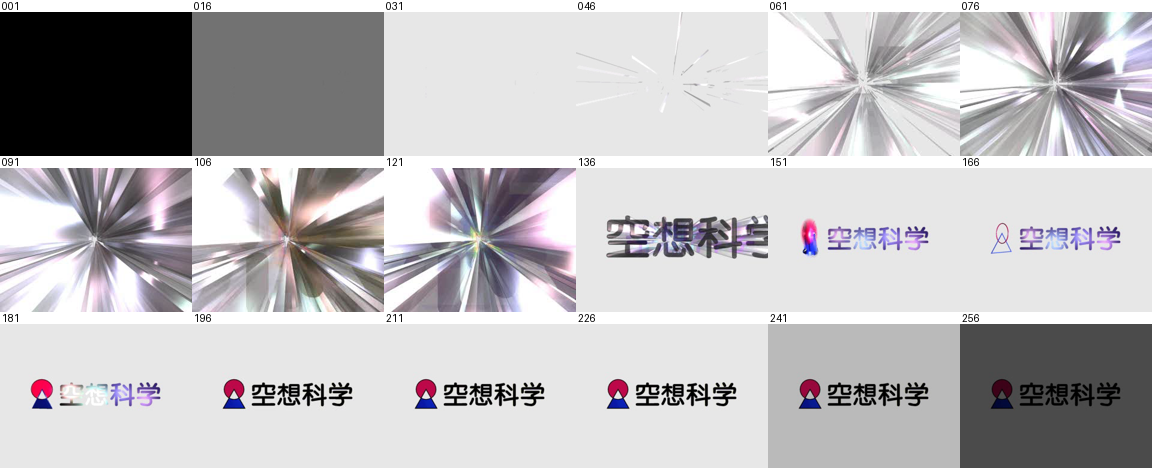
KUUSOU.STR: 270 frames of 320 × 240 at 30 frames a second, with mono sound.- Skipping. From the eleventh frame of a logo, any of START, △, ○, ✕ or □ jumps straight to loading
MAIN.EXE, skipping the movie and the logos after it. So whether the Kuusou Kagaku movie plays depends only on whether a button is pressed during the ASCII logo. - Nothing at boot is random. Neither the boot program nor the launcher has a random-number generator; the sequence is the same every time.
- A movie that isn't there. The table's first entry names
L_ASCII.STR, a 58-frame movie, which isn't on the US disc. The entry shows the ASCII still instead.
The horse at boot#
Players have long reported that, once in a while, a different logo shows right after the white Kuusou Kagaku logo: a knight on a rearing horse over "ΛSCii SOFT". And then the console freezes. It is real, and the project made it happen on demand in Redux.
The horse is DUMMY.STR, the file that sits on the disc directly after KUUSOU.STR (sector 12306 = 10946 + 1360). It is the old ASCII SOFT logo movie: 59 frames at 15 a second, about four seconds with stereo sound, a glint across the knight and then a fade to black. Its length fits the 58 frames the table gives L_ASCII.STR, and RPG Tsukuru 3 ships the very same movie as its L_ASCII.STR, with a second copy as its own DUMMY.STR. The US release deleted the named file and kept the padding copy.
The movie player reads the disc sector by sector from the file's start and never looks at the file's size. It stops only when the frame number in a video sector reaches the table's count, 269, or when a button is pressed. KUUSOU.STR numbers its frames 1–270, so either of its last two frames ends it. Those two frames are its last nine video sectors, about the last sixteenth of a second of reading. If both are lost, nothing reaches 269: the stream runs on into DUMMY.STR, whose frames are numbered 1–59, plays the whole horse, and then waits for a next frame that never comes.
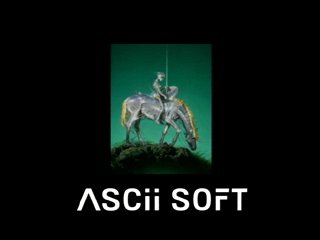
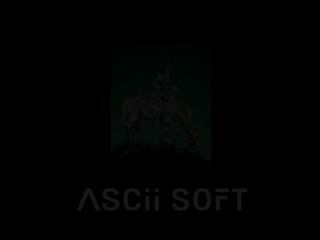
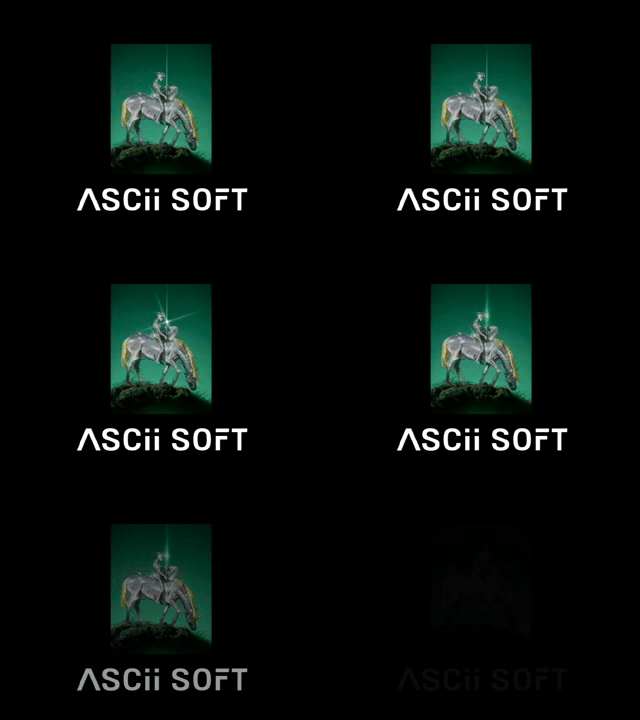
DUMMY.STR, the ASCII SOFT horse, decoded from the disc.- The test. A copy of the disc image with the headers of chosen video sectors blanked, so they are never delivered, as a bad read would do. With frames 269 and 270 dropped, the horse plays and the screen freezes. Short presses of START, ✕, ○ and SELECT+START do nothing, nor does holding START or ✕ for 1,200 frames: only a reset gets out. Losing only one of the two frames boots normally.
- One sector of each frame is enough. The player drops a whole frame when any of its sectors is missing, so losing the first, a middle or the last sector of each frame gives the horse just the same.
- Why only sometimes. No code decides it. The two frames go missing when the drive fails to read the end of the movie: a read error or a retry at that spot (a scratch or dirt at that radius of the disc), or the player dropping frames while the decoder is behind. And the intro has to play untouched, since any button press during the ASCII logo skips the movie.

KUUSOU.STR, then the horse, then the frozen last frame.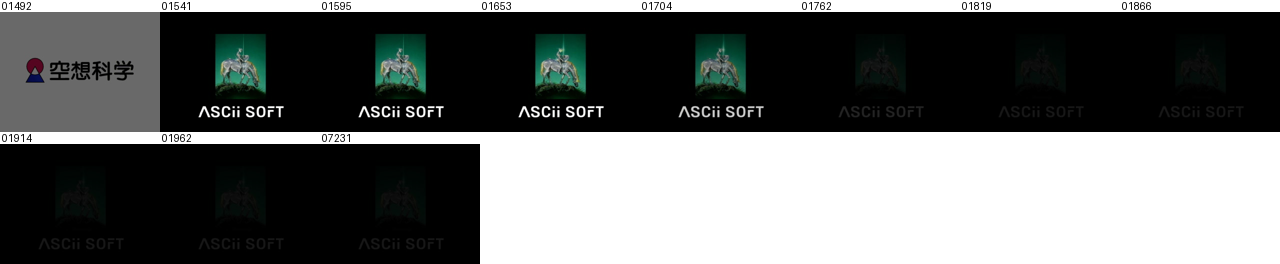
Dormant screens#
Five screens are in the program, whole or nearly, with nothing that opens them. Each was opened in Redux by pointing an existing menu entry at it.
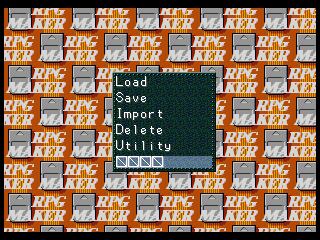
The hidden MEMORY CARD row#
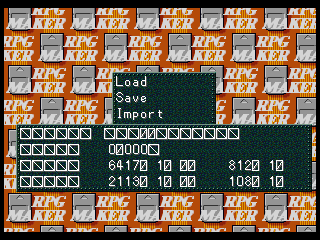
EDIT → MEMORY CARD's menu has a sixth row. Its list is built for six rows, its sixth label is in the file and its jump table leads row 6 to a page of its own, but the code that opens the menu writes "last row = 4" (five rows) on every open, one short. Changed to 5, the menu grows a row titled 「圧縮情報」, "compression info", that opens a report on the save compression: labels for the time taken, the System Data and the Scenario Data, and a 「圧縮不可」 ("can't compress"). The US font has no kanji, so every Japanese label draws as boxes; the figures work. The columns weren't decoded; on blank data they read 64170 and 8120 for System, 21130 and 1080 for Scenario, probably the sizes before and after compression. The compression itself is on the How it works page.
The under-development screen#
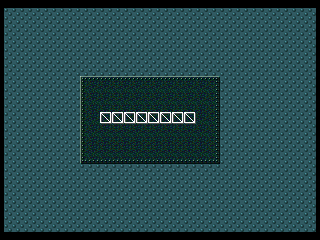
Task class 0x15 opens a window that says 「現在開発中です。」, "Currently under development.", and closes on ✕ or ○: a stand-in for a screen that wasn't finished. Nothing starts class 0x15.
The PC-host file browser#
OVERLAY section 0x16 is a development tool. It loads and saves the System Data and the Scenario Data to files on the developers' PC, through the host calls of a development kit (c:/ptcl/game/edit/sys_00.edt, scn_00.edt and so on, ten slots each). A retail console can't answer those calls; Redux can, and the tool works there byte for byte.
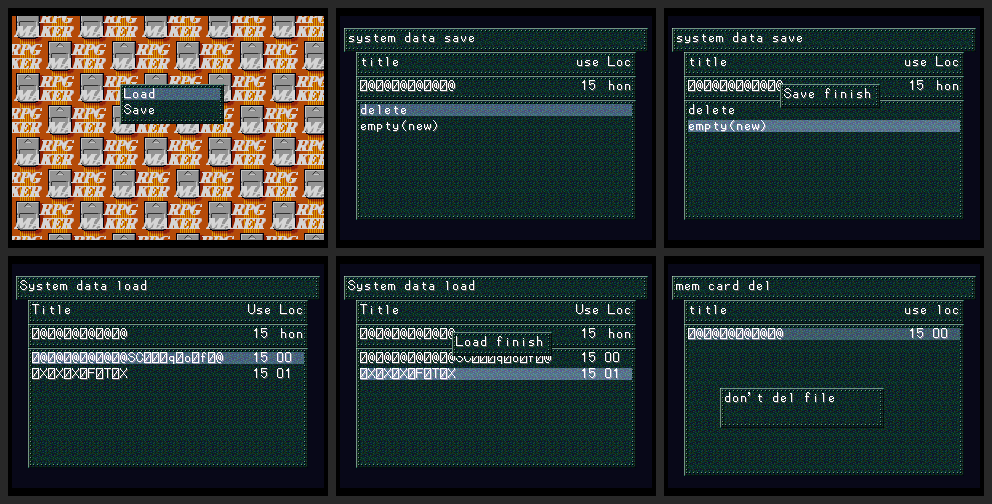
- Its root page is a dead end. It shows Load and Save over the tiled RPG MAKER background, but either choice just closes it. Opening a sub-page takes a second patch.
- Load offers System, Scenario, "animetica" and "kanadel". Animetica (アニメティカ) is Anime Maker's Japanese name; kanadel is Ongaku Tsukuru Kanadeeru 2, the series' music maker on the PlayStation. Those two rows load into the import bookkeeping, where RPG Maker keeps what it imported from the companion programs; their labels are swapped against the titles of the pages they open.
- Save writes System or Scenario only; its "delete" row can't delete (the host calls have no delete), and errors are ignored: a failed write still says "Save finish".
- A file is a raw dump of RAM: the save header as it sits in memory, then the System or Scenario data uncompressed, in whole 8 KB chunks. A System file built from Arc Arath's System save loaded whole, and Character Edit listed its cast: the System Data password never comes up on this path.
- It probably predates the compression. The chunk count comes from the header's block count, which for a Scenario only the MEMORY CARD menu fills in. Before a visit to that menu a Scenario save writes one chunk and can't be loaded back.
Battle screen darken#
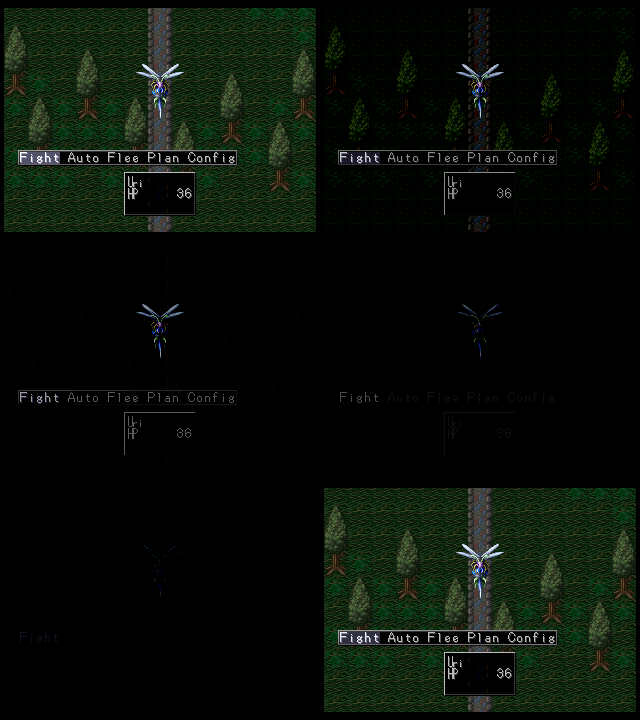
The battle overlay holds a 16-frame fade to black: a dark, see-through tile laid over the whole battle screen a little deeper each frame. Nothing calls it. Started by hand at the party menu, it sinks the backdrop, the monster and the windows into black; then, since nothing ends the battle, the next frame is the normal screen again. It was probably meant for leaving a battle.
Field Edit's old town-delete page#
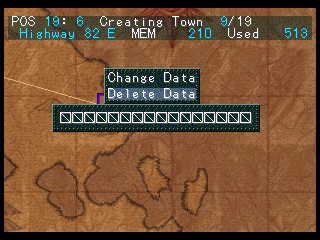
Field Edit once refused to delete a town that had roads, with a page saying 「道データがあるので削除できません」, "there is road data, so it can't be deleted". The shipped editor deletes the town's roads with it instead, and the page and its check were left unconnected. The check itself is a slip: it would only match a road from the town to itself.
Overlay sections never loaded#
Of OVERLAY.BIN's 25 sections, three (0x10, 0x13 and 0x17) are named by nothing that loads code or data, and three (0x13, 0x15 and 0x18) are four-byte placeholders. RPG Tsukuru 3's disc has the same sections, byte for byte. How it works lists all 25.
| Section | Size | What |
|---|---|---|
| 0x10 | 2,392 bytes | A text test: 「一行目」 ("line 1") followed by the first kanji in JIS order, 「二行目」 ("line 2"), rows of full-width digits and the letters abcdefgh. Loaded in neither build. |
| 0x13, 0x15, 0x18 | 4 bytes each | A single word. Two editor entries past the end of the list point at 0x15 and 0x18; nothing loads 0x13. |
| 0x16 | 13,260 bytes | The PC-host file browser, above: named by an editor entry that nothing chooses. |
| 0x17 | 27,418 bytes | The grids of the Japanese name-entry keyboard (below). RPG Tsukuru 3 loads it every time its keyboard opens. |
Section 0x12 looks like a leftover, a big table of numbers, but isn't: Field Edit loads it as the table that tells which world-map parts may sit next to which.
Japanese left inside#
RPG Maker is the translation of RPG Tsukuru 3, and the translation took out the Japanese only where it showed. Behind it are a whole text engine, a keyboard and a dozen strings.
The Japanese text engine#
The program's text printer has seven modes, and the US game uses only one, the 8 × 12 English font. The others print two-byte Shift-JIS text at two spacings or through a second path, turn packed one-byte text into Shift-JIS (two modes), or use the small 8 × 8 font. The wrappers that pick them are dead code. The US kept the tables that map a Japanese character to its place in a font, the same as RPG Tsukuru 3's, but cut the lookup itself to a stub that gives every two-byte character the same cell. That is why every Japanese leftover on this page draws as a row of boxes. The engine itself is described on the How it works page.
The Japanese keyboard#
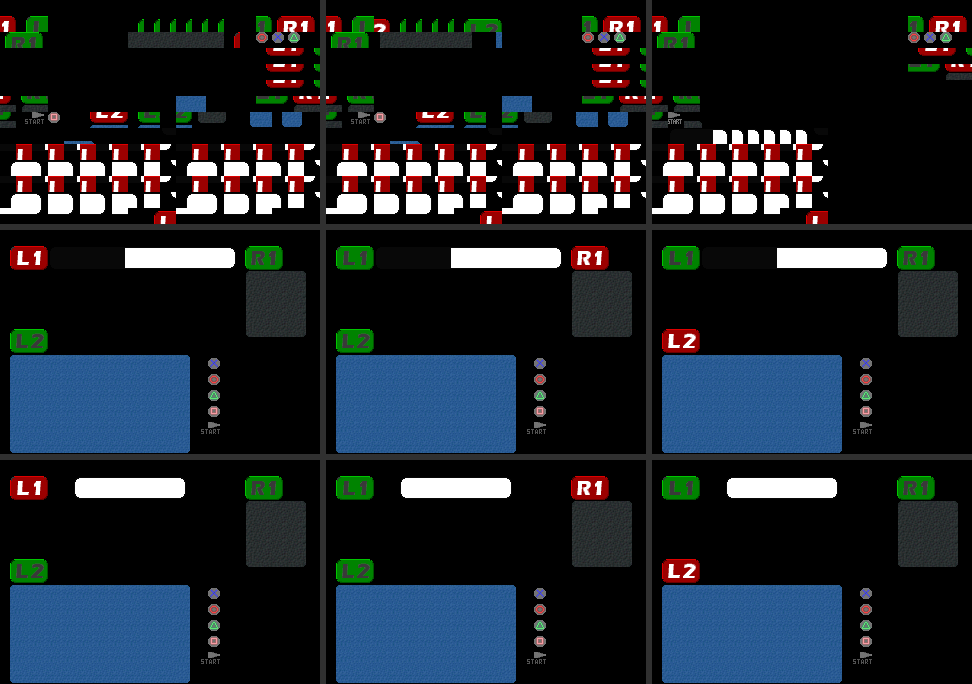
RPG Maker's text-entry keyboard draws a plain alphabet from a grid kept in the program. The Japanese keyboard is still on the disc in three pieces, none of them loaded:
- OVERLAY section 0x17, its grids: half-width katakana, full-width and plain letters and digits, and the links that move the cursor between keys.
- COMDATA 35F, a smaller copy of the same data.
- COMDATA 356–358 and 361, four backdrop layouts with two ten-key grids side by side where the US screen has one: the shape of a kana keyboard with two tables. They number their tiles for a tile sheet that isn't on the US disc, so the US sheet draws them scrambled.
Strings that were never translated#
| Text | Means | Where | Can it show? |
|---|---|---|---|
| 「現在開発中です。」 | "Currently under development." | the dormant screen of task class 0x15 | only by patching (above) |
| 「圧縮情報」 and the report's labels | "compression info", "time taken", "system", "scenario", "can't compress" | the MEMORY CARD menu's switched-off row | only by patching (above) |
| 「道データがあるので削除できません」 | "there is road data, so it can't be deleted" | Field Edit's old town-delete page | only by patching (above) |
| 「ハードディスクのファイルがいっぱいです」 | "the hard disk's files are full" | the PC-host file browser | only on a development kit |
| 「無し」 | "none" | the item description's accessory-effect line | no: the caller skips effect 0 |
| 「フィールド指定 なし」, 「街の指定 なし」 | "no field / town specified" | the first row of the field and town pickers | no: every caller starts the cursor below that row |
| 「テスト用 ダミーデータ」 | "dummy data for testing" | the card overlay's save-header templates | no: overwritten before every write |
| 「RPGツクール3 システム 新しいデータ」 | "RPG Tsukuru 3 System New Data" | the System header in RAM | no: a real save gets the English title |
| 「内部外部 場面」 | "inside / outside — scene" | the end of Dungeon Edit's category table | no: nothing reads it |
The development build's paths are left in the program too, beside the disc paths: C:\PTCL\GAME\DATA\COMDATA.BIN, …\SOUND\SOUND0.BIN and …\OVERLAY\OVERLAY.BIN. On a console they are never used.
Unused pictures in COMDATA#
COMDATA.BIN holds 899 entries. Decoded tables name 811 of them (the 249 map sets, the wallpapers, the world map, the object and character pages, the 100 monster pictures, the title pictures, the fonts, the effects), the program's load lists and the two map editors name most of the rest, and a trace of every disc read while the game ran found nothing outside those. What is left:
| Entries | What | Status |
|---|---|---|
| 161, 163, 165–167 | An alternate Lab tileset: three pages, a palette-number table and an attribute table | no map set names it |
| 324–32B, 33C–353 | 32 tiny 4 × 4 pictures, beside 16 more (32C–33B) that the game loads at boot | never loaded |
| 37E–380 | A tenth title picture: its palette and its two halves | nothing refers to it |
| 2CB | Monster picture 100 | in the table, but number 100 means an import |
| 356–358, 361 | Four layouts of an older name-entry keyboard | never loaded; RPG Tsukuru 3's live keyboard |
| 35F | The name-entry keyboard's grids, a smaller copy of OVERLAY section 17 | never loaded |
| 2A0 | A kind for each world-map tile: map, parchment, town icon | never loaded; probably for an editor's tile picker |
| 2A1, 2A8, 2AA | Copies of tables the program keeps in its own data: the world-map tiles' attributes, the 64 parchment tiles, the common objects' palette numbers | the program uses its own copies |
| 2AD | An older draft of the common objects' attributes | the program uses its own table |
| 314 | 202 bytes of bookkeeping keyed to the character pages | never loaded; RPG Tsukuru 3 has the same unused entry |
Entries 320 and 321 look unused at first but aren't: they are the sample game, Gobli's Adventure, loaded by Load Sample and GAME's Sample.
The alternate Lab tileset#
COMDATA 161, 163 and 165–167 are a whole map set's graphics that no map set uses: three pages of tiles, the table that gives each tile its palette, and the table of its attributes. The art is the biomechanical style of the eight Lab map sets (151–158), the same 24-pixel grid of the same drawings, but edited: walls of a different design, parts moved and redrawn. Its attribute table marks 237 floor-layer parts and 31 see-through objects, where the shipped set has 249 parts and 45 objects. Every Lab layer on the disc fits the shipped tiles better, so no sample map was ever laid out for these. The map sets themselves are on the Map sets and tiles page.
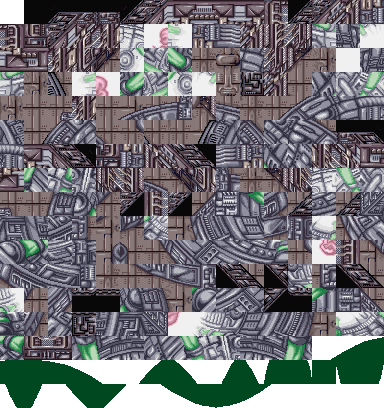
| Compared with the shipped Lab tiles | Tiles |
|---|---|
| identical | 61 |
| touched up (90–99 % of the pixels the same) | 56 |
| edited (60–89 %) | 74 |
| reworked (30–59 %) | 42 |
| new | 34 |
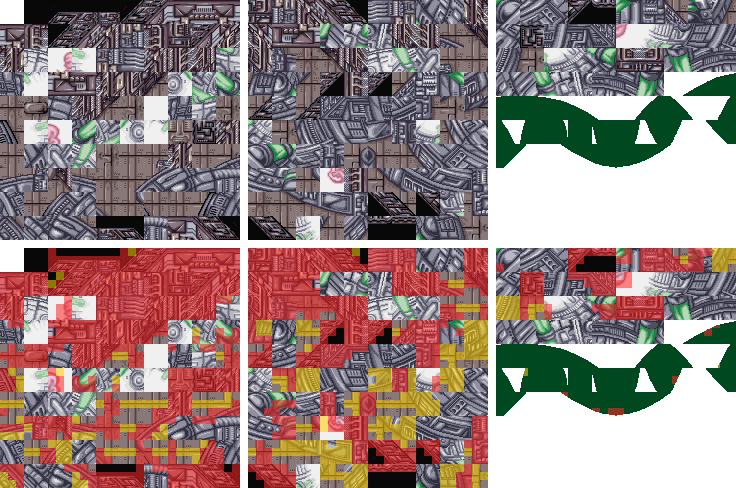
Swapping each shipped part for its closest unused tile rebuilds 81–90 % of each Lab room's floor layer, with seams as smooth as the original's:
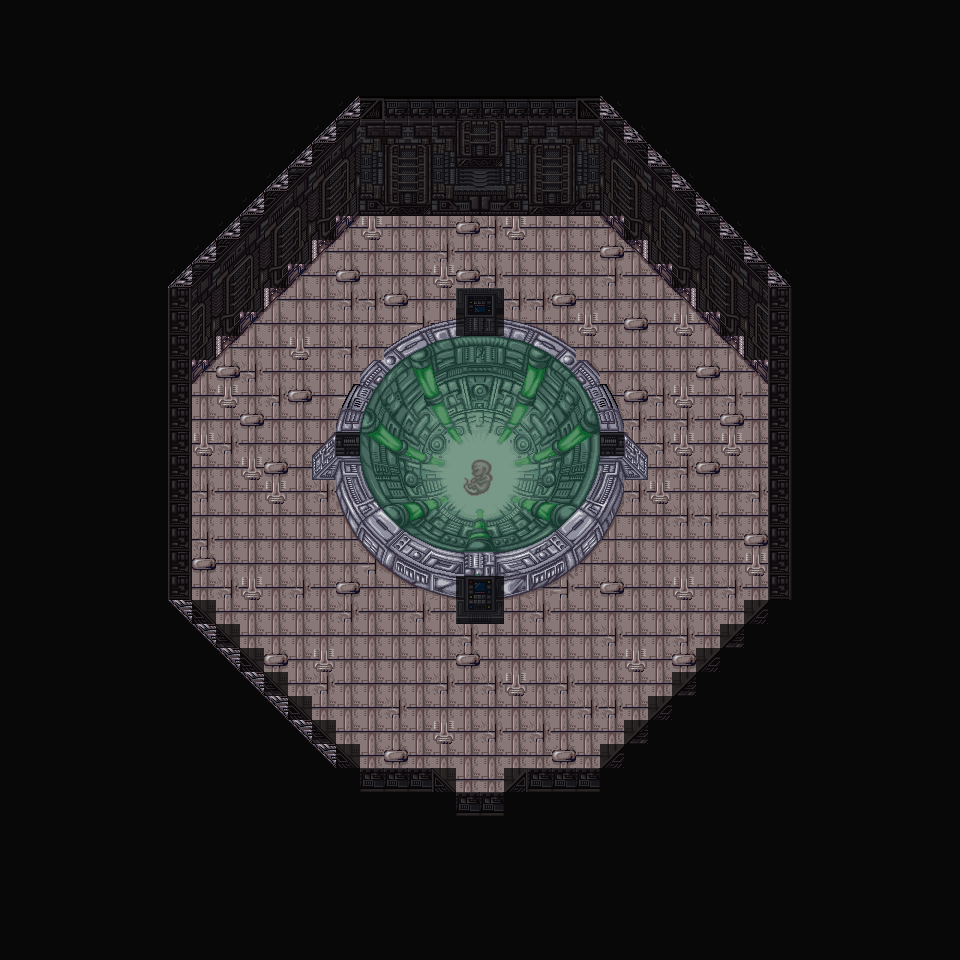
The unused set's nine palettes also set the see-through bit on every colour, where the shipped set sets it only on the objects' glass. Only see-through parts read that bit, and in both sets those are the objects, so it changes nothing on screen.
A tenth title picture#
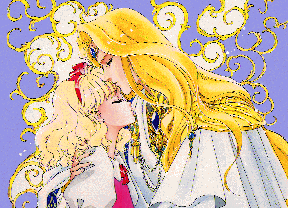
COMDATA 37E–380 hold a tenth title picture, in the same three-file layout as the nine that Title Edit offers (a palette and two halves of a 288 × 208 picture). It is a full illustration in a style unlike the nine: two long-haired blond figures in an embrace, against gold scrollwork on lavender. Nothing refers to it, and the code has no number left for it: title picture numbers from 10 up mean an imported picture.
Monster 100#
COMDATA 2CB is a hundred-and-first monster picture: a 240 × 120 horned figure that fills its frame, skull-faced between two energy curtains, with its own default name, 扉 ("door" or "gate"), the only name never translated, and the largest size class. It is in the monster picture table, but the editor can't pick it, because monster graphic number 100 means the first imported monster. RPG Tsukuru 3's guidebook lists only 0–99, so it was cut before the Japanese release too. Overlord ("Demon King") has the same curtains, so it is probably the demon he summons, meant as a seventh and final boss. The monsters the game does offer are on the graphics page.
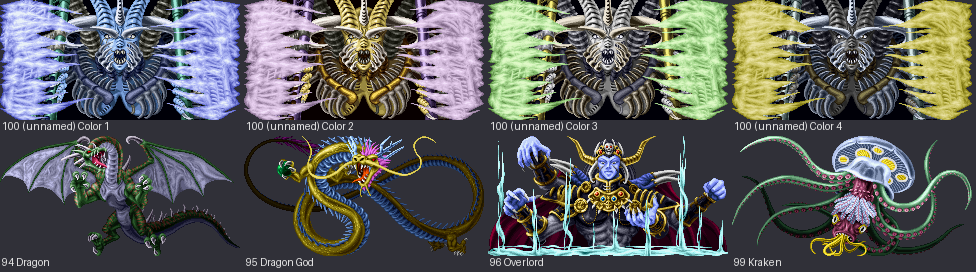
It isn't hidden from picture rippers, only hard to recognise: it is a plain picture file right after the Kraken's, but its palettes are malformed, so the rippers that find it show it without colour, a dark blur. And since it is never loaded, a dump of video memory can't catch it.
Tiny pictures and stray tables#
COMDATA 324–353 are 48 tiny pictures of 4 × 4 pixels, one after another. The game loads the middle sixteen (32C–33B) at boot; the 32 around them it never loads. They are probably frames of one small animation.

The rest of the leftovers are tables: a kind for each world-map tile (map, parchment or town icon), probably for an editor's tile picker; three copies of tables that the program keeps in its own data instead; an older draft of the common objects' attributes, which agrees with the live one on whether 173 of the 194 objects block the way; and 202 bytes of bookkeeping keyed to where each character page starts, which RPG Tsukuru 3 also has and also never reads.
Leftovers of the song import#
RPG Tsukuru 3 can import songs made in Kanadeeru 2 from a memory card and play them as background music, numbers 36–50. The US release cut the import, but not all of it:
- The instrument bank. SOUND0's entries 3 and 4 are a second instrument bank, 105 programs laid out like General MIDI, that only imported songs use. The music loader still handles background music numbers above 35 with it; nothing asks for one.
- The decoder. Imported songs come packed in a format marked
LZC. Its decoder and a CRC-32 check are inRPG3.EXE, never called (dead code). Its long-window case reads one byte twice where it should read two, in RPG Tsukuru 3 too. - The PC-host browser's "kanadel" row, above.
- The import menu. RPG Tsukuru 3's MEMORY CARD register and delete menu has four kinds; its first row, かなでーるBGM, is the song import. The US menu has the other three. Imports are on the memory cards page.

The rest of RPG Tsukuru 3's song import is described on the RPG Tsukuru 3 page.
Dead code#
RPG3.EXE has 95 functions that nothing calls. Twenty-nine are empty, nineteen of them in one row; most of the others are the unused half of a pair, a "pop" beside the live "push", a "clear" beside the live "set", or a "close all" and "find" that tidier code would have used. Four more are reached only from dead code. The overlays have 12. Event Edit has none at all. The ones that are features:
| What | Where | What it would have done |
|---|---|---|
| Palette-cycle modes 1 and 2 | RPG3.EXE 0x80044BDC, 0x80044CA8 | Two more kinds of colour cycle: step through a list of stored palettes, or rock back and forth. Their per-frame code is live; only these two set-up functions are missing a caller, and every shipped cycle rotates. |
| An "LZC" file decoder and a CRC-32 | 0x80048AB4, 0x80048B1C, 0x80048D8C | Unpacks a header-checked LZSS file marked LZC. Its long-window case reads one byte twice where it should read two. RPG Tsukuru 3 uses the same code, slip included, for songs imported from Kanadeeru 2 (above). |
| Smooth scrolling for the text grid | 0x8002E380, 0x8002E3E4 | Switches the text grid's pixel offset on and off; the grid still honours it, but nothing turns it on, so text never scrolls by the pixel. |
| The two-byte text printers | six wrappers from 0x8002637C | Japanese text in Shift-JIS, three or four cells a character; the text engine above. |
| A sound-effect picker that previews with pitch | 0x80054B14 | A copy of the live picker's opener that plays the preview at the chosen pitch. Every live picker previews at the default pitch. |
| Music pause | 0x80019850 | Pauses the current song. Nothing resumes it, and nothing checks for the paused state. |
| PC file read and write | 0x8007B710, 0x8007B7E4 | Load and dump files on a development kit through SN Systems' PC calls. |
| Older layouts of two objects | 0x8002B09C, 0x800281B0 | The field-graphics object with a 100-byte header (the live one has 0x58), and a one-block map layer. |
| Indexed encounter lookup | 0x800543CC, 0x800544F4 | A quick index for Monster Appearance records; the game walks them one by one instead. |
BattleActor_SlideTo | battle engine 0x8011E754 | Slide a fighter to a place; the live code only slides by an amount. |
| A target-range test | battle engine 0x80124898 | Probably a helper for the monsters' AI. |
| Two Dungeon Edit helpers | Dungeon Edit 0x8010C074, 0x80118010 | A cursor update without the selection box, and a relative box move. |
| A class map for In Parts1 | Dungeon Edit, COMDATA 28D | Loaded every time Dungeon Edit opens and never read. |
| Two Monster Appearance helpers | Monster Appearance 0x801057BC, 0x80108B88 | A free-memory count (the same as Event Edit's) and the restore half of a view snapshot whose save half is called. |
| A no-Teleport test | field menu 0x8010CB14 | Teleport is refused if a flag bit is set, and nothing anywhere sets it: perhaps a "no Teleport here" map setting that never got its command. |
| A blocking card wait and a name fitter | MEMORY CARD 0x801055EC, 0x8010E250 | Wait for the card in one call (the live code polls once a frame), and shorten a long name with "~" in the middle. |
Anime Maker has 22 functions that nothing calls, all of them small: two empty ones, a string length, picture loaders, setters, a test for a grid cell and one for the cancel button. Nothing of note.
Values the editor can't produce#
The editors only write what they offer, but the program reads more than they offer. Hand-made bytes (or a patched editor) reach these:
| What | What the program does with it |
|---|---|
| Move Location methods 4–6 | 4 and 5 are a jitter dissolve to black or white; 6 crashes the game (below) |
| Event opcodes 0x3B–0x3E and 0x56 | the engine's own: map music, fade in, refresh every page, run a pending Take Over, Game Over. 0x3D works in any event (How it works) |
| Switch numbers past 500 | a bit of the game state after the switches: the treasure flags, bag counts, Gold, the camera (Limits) |
| Magic animation positions 7–11 and timings 6–11 | used by the weapon-hit animations, never offered for a spell |
| Monster graphic 100 | a whole unused boss (above) |
| A title text out-effect | the title never sets one; Game Over does |
| The credits script's step 12 | fade every line out and end; no step leads there |
| State machine modes 0–3, 8 and 9 | each just moves on to the next mode |
| A count for item 0 | equipping into an empty slot, or △ on one, adds item 0 to the bag; lists skip it, but saves carry it |
Move Location methods 4 to 6#
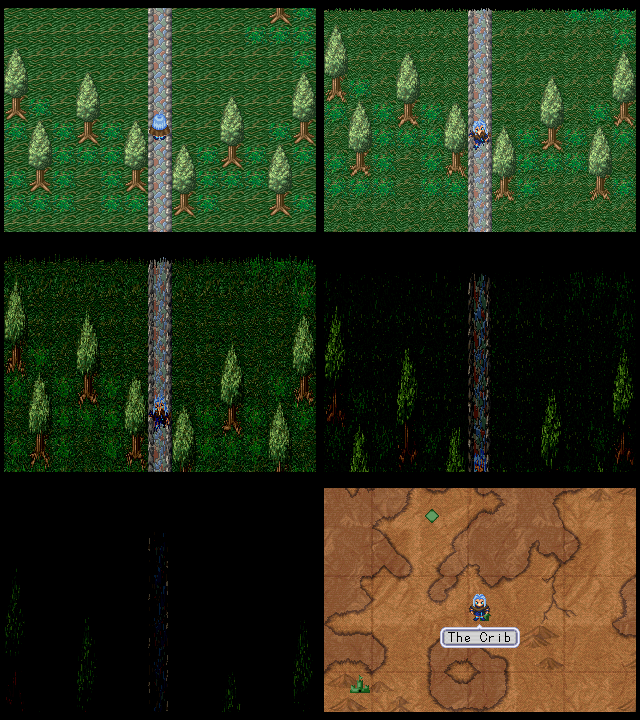
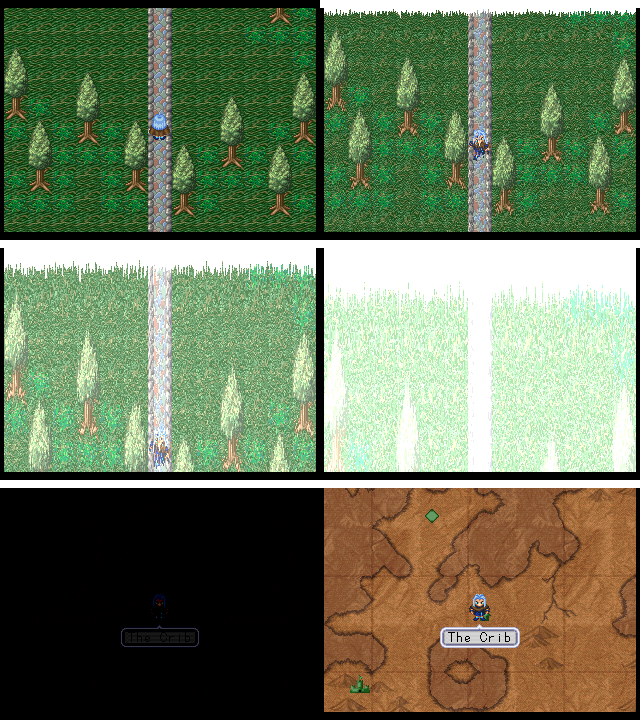
Move Location's Method picks one of the program's eight screen fades; the editors offer four of them (Black, White, Black Melt, White Melt), as methods 0–3. Methods 4 and 5 give the two fades nothing offers: a jitter dissolve, every column of the picture shaking by up to two pixels each frame while it darkens or whitens. Method 4 then pops the new map in with no fade at all; method 5 cuts to black for the load and fades in. Method 6 points past the end of the fade tables, and the game stops with an exception 14 frames later. No game in the community archive uses anything but 0–3. The fades are on the How it works page; Move Location itself on the events page.
Unused entries in the option lists#
The lists the editors show match RPG Tsukuru 3's one for one: the same title pictures, text effects, colours, fades and pickers. Two differences:
- Title Edit's picture list has an eleventh entry, kept for the name of a title picture registered from Anime Maker and empty until one is. RPG Tsukuru 3's list has ten.
- The MEMORY CARD import menu has three kinds, where RPG Tsukuru 3's has four: the Kanadeeru song row is gone (above).
Debug paths and button codes#
- There are no secret button codes. The only test of several buttons at once, in RPG Maker, its overlays, the launcher and Anime Maker, is L1+R1+START+SELECT, which leaves Test Play.
- Held buttons in Test Play. Holding ○ walks through walls and objects and stops random encounters; holding START while the leader stands still stops the party from moving, checking or opening the field menu. Playing a game has the rest of Test Play's tools.
- A test switch in the melt fade. While the d-pad's ↑ or ↓ is held, the Black Melt and White Melt fades skip their darkening for that frame: the picture melts without going dark. It looks like a leftover switch for testing the melt alone.
Anime Maker and the launcher#
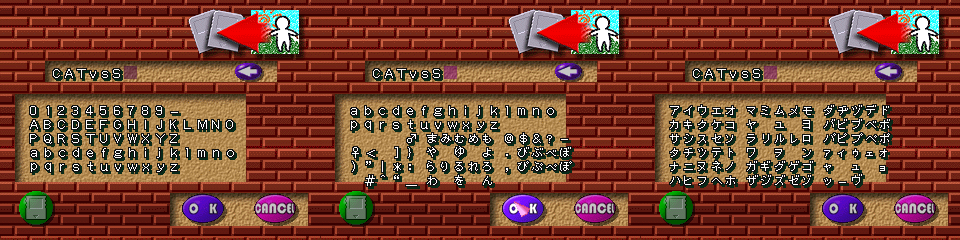
- The kana keyboards, with the page buttons removed. Both of Anime Maker's text-entry keyboards (the save-name entry and the Story editor's Line Editor) read a four-page layout table: hiragana, katakana and two pages of letters and digits. The US opens them on the two letter pages, and the buttons that switched pages were taken out of the windows, leaving the handlers and the kana pages behind. Switched back on in Redux, the katakana page draws whole (the US font still has every katakana); on the hiragana page about half the kana show and the rest are the punctuation that replaced them in the US font.
- Even restored, they would fail. The keyboards' click grids cover five rows where the windows print six, so the kana pages' sixth rows can't be typed. And a name in full-width kana makes the memory card file name longer than the console's 20 characters: the save stops with "MEMORY CARD is unreadable." and leaves an empty file that takes up blocks. Any name over 20 characters does the same, as the US code doesn't check the length.
- Every picture is used. All 51 entries of Anime Maker's picture archive are used; the three that aren't pictures are save-header templates in full-width English ("CHARACTOR", the original's spelling).
- The launcher starts only Anime Maker and RPG Maker. It keeps the path of an Anime Maker project folder on the developers' machine,
WORK\A_ANM_P.
The Anime Maker editors are on the Anime Maker page.