Compared with RPG Tsukuru 3#
RPG Maker is the American release of RPG Tsukuru 3 RPGツクール3, made by ASCII in Japan in 1997 and brought to North America by Agetec in 2000. It is the same program: the same engine, the same editors, the same 27 event commands, the same battle rules. What the localisation changed is the text and everything shaped by it, the music numbers, a song import that was cut, and the names on the menus. This page goes through the differences one subsystem at a time, says what carries over between the two and what doesn't, and places both in the Tsukuru line, between RPG Tsukuru 2 on the Super Famicom and RPG Tsukuru 4.
Nothing on this page is needed to make a game in RPG Maker. It is for players of Japanese games, for anyone curious about what the translators did, and for anyone moving a game from one to the other.
At a glance#
| Subsystem | RPG Tsukuru 3 | RPG Maker | More |
|---|---|---|---|
| Release | ASCII, Japan, 1997 (SLPS-01093) | Agetec, North America, 2000 (SLUS-00640) | Behind the scenes |
| Text | Japanese: kana and all 3,489 kanji of JIS level 1, each in a 12 × 11 cell | English, one byte a letter, in an 8 × 12 font | The text engine |
| Message lines | 18 characters a line, up to 30 lines a message | 27 characters a line, up to 36 lines | The text engine |
| Balloons | 8 characters | 12 characters | The text engine |
| Names (items, magic, monsters, maps …) | 16 bytes: a kana, digit or capital takes one, a kanji two | 12 letters | Names and lengths |
| Parameter names | 8 bytes | 6 letters | Names and lengths |
| Game title, staff names, staff titles | 36, 36 and 24 bytes | 18, 18 and 12 letters | Names and lengths |
| Scenario name | 16 bytes | 18 letters | Names and lengths |
| Name entry | A kana keyboard: tabs for hiragana, katakana, letters and two symbol pages, and a kanji panel chosen by reading | One grid of capitals, small letters, digits and punctuation | The keyboard |
| Title name on the title screen | Full-width letters and digits, ♪ ☆ Ⅰ–Ⅹ, a sword and a shield; no kana or kanji | Letters, digits, punctuation, ♂ ♀ ♡, two faces and “ | The title-name font |
| Confirm in menus | ○ | × | |
| Editor names | Japanese names, some different in meaning (職業, "job", for Skill) | English | Menus and names |
| Music | 35 songs, plus up to 15 songs imported from Kanadeeru 2 as BGM 36–50 | 35 songs; 17–35 in another order; no import | Music |
| Music fade-out | Stops at volume 1, after about 1 second | Down to silence over 2 seconds | Music |
| Graphics maker | Animetica アニメティカ | Anime Maker, its English version: the same picture files inside | Converting games |
| MEMORY CARD imports | Four kinds: Kanadeeru BGM, monster, character, title | Three kinds: monster, character, title | Music |
| Compression report on the MEMORY CARD menu | A sixth row while START is held as the menu opens | Switched off | The hidden MEMORY CARD row |
| Sample game | ゴブリくんの冒険, System gobli | Gobli's Adventure, System Gobli | The sample game |
| Monsters of one kind in a battle | A full-width letter after the name (A, B …) | A digit after the name | How battles work |
| Battle rules | The same: 2,082 decisions in 16 battles replayed without a difference | — | Battles and events |
| Event commands | The same 27 commands (92 codes), the same sizes, but Next Scenario's name is 16 bytes | Next Scenario's name is 18 letters | Battles and events |
The program file still carries the old name: the editor and player is RPG3.EXE on both discs (How it works). The two discs lay out their files the same way, and the sound bank, two of Anime Maker's files and three of the overlay sections are byte for byte the same. The rest was rebuilt: RT3's RPG3.EXE is 1,005,568 bytes, the US one 1,079,296.
Menus and names#
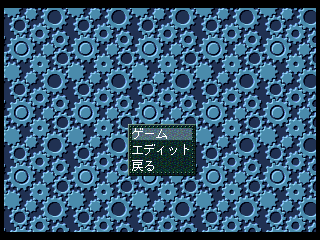
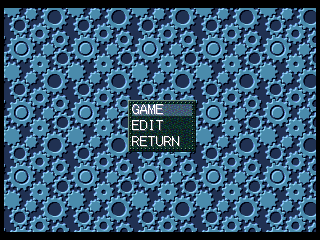
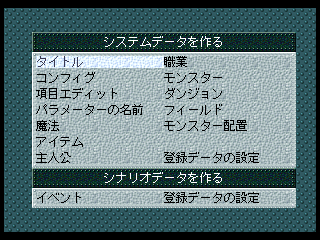
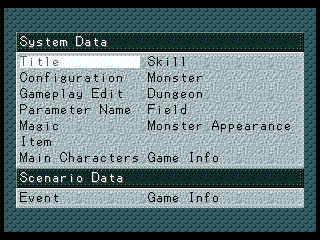
RT3 asks you to confirm with ○; RPG Maker uses ×, as its manual says. The menus have the same rows in the same places, under Japanese names. Some of those names say more than the English ones: the Skill editor is 職業, "job", and Gameplay Edit's Abilities switch reads "the effects that come with a job", where RPG Maker says "Skill effects". A Skill in RPG Maker is a character class, and RT3 calls it one.
| Where | RPG Tsukuru 3 | In English | RPG Maker |
|---|---|---|---|
| Top menu | ゲーム / エディット / 戻る | Game / Edit / Back | GAME / EDIT / RETURN |
| GAME's third row | サンプルゲーム | Sample game | Sample |
| Edit Data, first heading | システムデータを作る | Make System Data | System Data |
| Edit Data | タイトル | Title | Title |
| Edit Data | コンフィグ | Config | Configuration |
| Edit Data | 項目エディット | Item edit | Gameplay Edit |
| Edit Data | パラメーターの名前 | Parameter names | Parameter Name |
| Edit Data | 魔法 | Magic | Magic |
| Edit Data | アイテム | Item | Item |
| Edit Data | 主人公 | Hero | Main Characters |
| Edit Data | 職業 | Job | Skill |
| Edit Data | モンスター | Monster | Monster |
| Edit Data | ダンジョン | Dungeon | Dungeon |
| Edit Data | フィールド | Field | Field |
| Edit Data | モンスター配置 | Monster placement | Monster Appearance |
| Edit Data | 登録データの設定 | Registered data settings | Game Info |
| Edit Data, second heading | シナリオデータを作る | Make Scenario Data | Scenario Data |
| Edit Data | イベント | Event | Event |
| Edit Data | 登録データの設定 | Registered data settings | Game Info |
| MEMORY CARD | データロード / データセーブ | Data load / data save | Load / Save |
| MEMORY CARD | 外部データ登録 / 外部データ削除 | Register / delete external data | Import / Delete |
| MEMORY CARD | ユーティリティー | Utility | Utility |
| MEMORY CARD, kinds to import | かなでーるBGM / モンスター / 人物 / タイトル | Kanadeeru BGM / monster / person / title | Monster / Character / Title |
Both builds' Game Info rows are RT3's 登録データの設定, "registered data settings", on both halves of the list. The editors' own title bars use the names of System Data and the other chapters.
Option lists#
The editors offer the same choices in both builds. Every menu, picker and grid in the program is opened from a small record that gives its rows, columns and steps. RPG Maker has 257 of them and RT3 260, kept in the same order, and 244 are the same. The rest differ for three reasons: the song import, the kana keyboard, and Japanese labels too wide for a single column.
| Where | RPG Maker | RPG Tsukuru 3 | Why |
|---|---|---|---|
| MEMORY CARD, Import and Delete: the kind | 3 rows | 4 rows | RT3's first row is かなでーるBGM, a song from Kanadeeru 2 |
| The keyboard | one 15 × 6 grid | a 13 × 5 character panel, a row of tabs and an 8 × 5 kanji panel | the kana keyboard |
| Gameplay Edit | five switches in a column | the same five in a 2 × 3 grid | room for the Japanese labels |
| Event Edit, page conditions | 12 choices in a column | the same 12 in a 2 × 6 grid | the same |
| The party's battle commands | two lists, for the two command counts | one list whose width is set when it opens | the same commands, chosen by the same battle flag |
| Title Edit, Screen | None, nine pictures and an 11th entry for an imported title | None and the same nine | the US list adds a row for the imported title's name; the tenth picture on the disc is unused in both |
| Magic Edit, Item Edit, MEMORY CARD pages and a few more | — | — | cell widths and steps only |
The limits in the code are the same too. Where a constant differs between the builds, it is because names are 4 bytes longer in RT3 (a copy page that counts to 21 in RPG Maker counts to 25 in RT3), because of the song import, or because the other compiler laid out a switch another way.
The text engine#
RPG Maker kept RT3's Japanese text engine and switched it off. RT3 draws text from a kanji font of 3,489 characters: the kana, Latin, Greek and Cyrillic letters, symbols and every kanji of JIS level 1, each in a 12 × 11 cell. The font is three entries of RT3's data archive, packed four fonts' worth to a page by storing each glyph in one bit of the 4-bit pixels. RPG Maker kept the code and the tables that turn Japanese text into glyphs, cut the glyph lookup down to a stub that always answers "a box", left the font out, and added a mode that prints one byte a letter in its 8 × 12 English font. That is why the few Japanese strings left in RPG Maker show as boxes (The Japanese text engine).
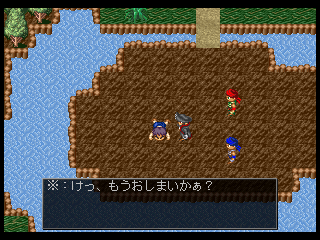
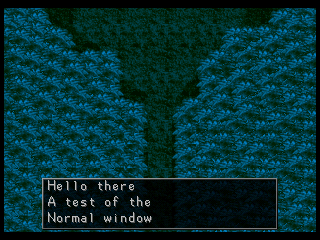
The windows are the same size in the same places. What changes is how much they hold:
- Normal messages, Message 1 and Message 2: 18 characters a line in RT3, 27 in RPG Maker. Event Edit lets a message run to 30 lines in RT3 and 36 in RPG Maker. Games made in RT3 keep to these limits exactly: across the three on hand and RT3's own sample game, 4,893 messages, no line is longer than 18 and no balloon longer than 8.
- Balloons: 8 characters in RT3, 12 in RPG Maker. RT3's balloon is 12 pixels wider for each character, RPG Maker's 8.
- Message 2's dark band is one pixel row shorter in RT3 (75 rows against 76), so its lower edge fades a row higher. Every frame of RT3's Message 2 fade was checked against a drawing made this way: all 49 exact.
- The battle party window squeezes RT3's 11-pixel glyphs into 7 pixels to fit; RPG Maker draws a thin 5 × 12 font there instead.
RT3 stores text packed: one byte for each kana, digit or capital letter, through a table of 200 codes, and two bytes, Shift-JIS, for kanji and symbols. RPG Maker stores one byte a letter. So a name of 16 bytes in RT3 holds 16 kana or 8 kanji, and a translation has to fit 12 letters.
RT3 also has a few glyphs of its own, written as two-byte codes: ♪, ♡, the Roman numerals Ⅰ to Ⅹ, a sword and a shield. RPG Maker's font has a heart but no musical note.
The title-name font#
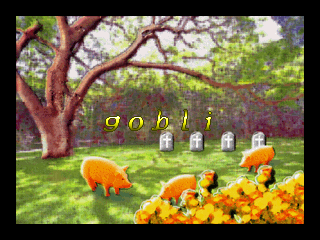
Display Title and Title Edit's preview draw the game's name in a separate 24 × 24 font in four colours. RT3's has no kana or kanji: 91 glyphs of full-width Latin letters, digits, a little punctuation, ♪ ☆ ♡ ♂ ♀, Ⅰ to Ⅹ, a sword and a shield. So an RT3 game writes its title in Latin letters, as its own sample does: gobli.
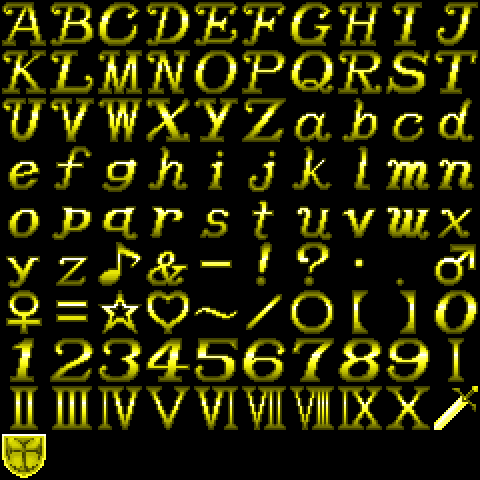
RPG Maker kept 72 of those glyphs as they were (the letters, the digits, & - ! ? /, the brackets, ♂ ♀ ♡), redrew three, and added the rest of ASCII, two faces and an opening quote. It dropped ♪, ☆, the Roman numerals, the sword and the shield (Title Edit).
Names and lengths#
Every name in RT3's System Data is 16 bytes where RPG Maker's is 12, and everything else in each record follows the name in the same order. So a record is 4 bytes longer in RT3, and the limits are the same: 230 magic, 250 items, 15 characters and skills, 250 monsters, 8 field maps, 990 dungeons (Limits). The other text fields:
| Text | RT3 | RPG Maker |
|---|---|---|
| Item, magic, monster, character, map and town names | 16 bytes | 12 letters |
| Parameter names | 8 bytes | 6 letters |
| Game title | 36 bytes | 18 letters |
| Staff titles / staff names | 24 / 36 bytes | 12 / 18 letters |
| Scenario name, and Next Scenario's | 16 bytes | 18 letters |
| Leader's name in a save's title | 8 characters | 8 letters |
The editors' default names change too: RT3's new title is "NEW TITLE" with staff "GAME DESIGN", "DESIGN", "SCENARIO", "THANKS" over "AAA" to "DDD"; RPG Maker's are the same words in mixed case.
The keyboard#
RT3 types Japanese. Its name-entry screen has tabs for hiragana, katakana, Latin letters and two pages of symbols on L2, and a kanji panel on R2: choose a reading (あ, あお, あか …) and the panel offers the kanji read that way. Its R1 menu is Finish, Insert, Input and Register.
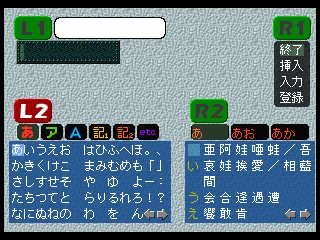
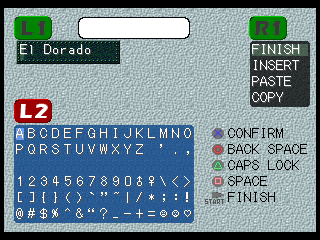
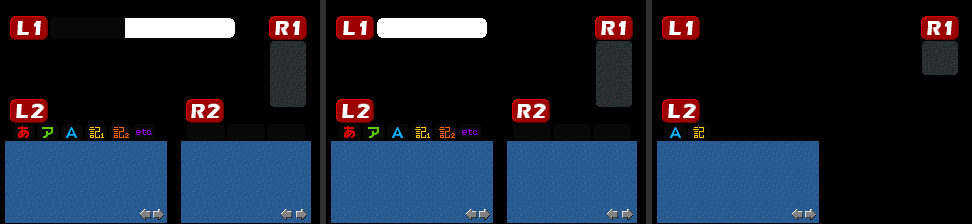
RPG Maker replaced the keyboard's backdrops, its tile sheet and its grids with its own, and moved its alphabet grid into the main program. RT3 loads its keyboard's grids from an overlay section that RPG Maker carries on the disc but never loads, and RPG Maker's data archive still holds RT3's three keyboard backdrops, unused (The Japanese keyboard). Drawn with RT3's own tile sheet, they are RT3's screen:
Music#
The Kanadeeru 2 song import#
RT3 could play songs written in Ongaku Tsukuru Kanadeeru 2 音楽ツクール かなで~る2, ASCII's music maker for the PlayStation, released in March 1998, three months after RT3. Kanadeeru 2 exports a song as a card file made for RT3. RT3's MEMORY CARD menu registers it like an Anime Maker picture, as kind かなでーるBGM, in one of 15 song slots, BGM 36 to 50, and from then on every BGM picker in the editors (Configuration, Title Edit, Dungeon Edit, Field Edit, Event Edit) runs to 50 and lists the song by its name. A page warns not to change the song in Kanadeeru afterwards; to change it, delete it and register it again.
In play the songs behave like the built-in ones, played on a General MIDI-style bank of 105 instruments. When a game starts, RT3 looks for its songs on the cards first, before the monster and character pictures, and asks for a missing one by name.
RPG Maker cut every path that feeds this: the menu row, the register code, the picker's top number (35 again) and the code that unpacks an imported song. The instrument bank is still on the US disc, and the program's sound loader still has a branch for BGM numbers above 35, which nothing asks for (Leftovers of the song import).
The song numbers#
The US release renamed the 35 songs and put 17 to 35 in another order. Both programs point at the same songs on the disc; only the numbering differs. The manual printed RT3's list in RT3's order, so its numbers 17 to 35 are wrong for RPG Maker (Corrections).
| RPG Tsukuru 3 | Song, as the manual names it | RPG Maker | Editor's name | Listen |
|---|---|---|---|---|
| 1–16 | BATTLE 1 … HOME | 1–16 | Battle 1 … Home 1 | |
| 17 | OPEN 1 | 20 | Opening 1 | |
| 18 | OPEN 1S | 21 | Opening 2 | |
| 19 | OPEN 2 | 22 | Opening 3 | |
| 20 | OPEN 2S | 23 | Opening 4 | |
| 21 | SKY | 17 | Home 2 | |
| 22 | TOWER | 24 | Tower | |
| 23 | TOWN 1 | 25 | Town 1 | |
| 24 | TOWN 2 | 26 | Town 2 | |
| 25 | TOWN 3 | 27 | Town 3 | |
| 26 | BAROQUE | 28 | Town 4 | |
| 27 | DANCE | 29 | Town 5 | |
| 28 | GAG 1 | 31 | Shop 1 | |
| 29 | GAG 2 | 32 | Shop 2 | |
| 30 | KANKYO 1 | 34 | Dialogue 1 | |
| 31 | KANKYO 2 | 35 | Dialogue 2 | |
| 32 | MO | 18 | Home 3 | |
| 33 | POP | 33 | Shop 3 | |
| 34 | REGE | 19 | Home 4 | |
| 35 | SANBA | 30 | Town 6 | |
| 36–50 | songs imported from Kanadeeru 2 | — | (none: the import was cut) |
The sound effects, 1 to 78, are the same in both, and so are the graphics: every picture of the dungeon map sets, wallpapers, characters, monsters and title backgrounds has the same number in both editors.
RT3's sound driver#
RT3 was built with an older version of Sony's sound library. Played side by side the songs sound the same, but:
- Pitch comes from a different table: notes come out up to about an eighth of a semitone lower, most by less.
- Fading out, a song stops at volume 1 after about a second, where RPG Maker fades to silence over two.
- RT3 keeps the General MIDI bank 48 bytes lower in sound memory.
All 13 of THE EVENT OF TODAY's songs, and a fade-in, were logged in RT3 and replayed through a model of RT3's driver without one differing write to the sound chip: 847,088 writes.
The sample game#
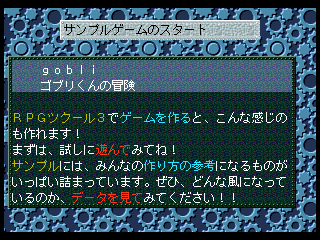
RT3's sample game is ゴブリくんの冒険 (System gobli), and RPG Maker's Gobli's Adventure is its translation. Both are kept in the program's data archive and loaded by the same code, from GAME's Sample row and EDIT → Load Sample (The sample game).
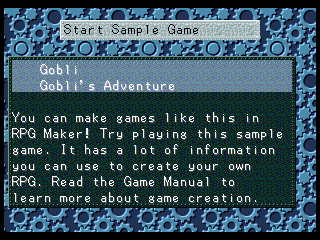
The translators rebuilt it in the editor. The structure is the same: 75 event blocks for the same 74 maps, 1,949 commands, the same count of every command. What differs:
| What differs | How much | What it was |
|---|---|---|
| Display Message | 408 messages | the text, written afresh in English |
| Change BGM | 35 commands | 34 are the same songs under their new numbers; one, on map 4, is a different song |
| Move Location | 13 commands | all to towns on the world map, which the US lists in another order: each still goes to the same town |
| Change Color (Quick) | 1, on map 49 | the US version tints the characters too |
| Character Direction | 1, on map 32 | another facing |
| Page headers | 33 | sprite colour or facing (19), which treasure flag a chest checks (7), Touch against Do Not Start (4), the sprite (2), one condition dropped (1) |
| Magic | 28 of 29 spells | only the message: RT3 gives each spell a verb, the US uses the bare "~ !" for all of them |
| Monsters | 21 of 36 | only the bit Monster Edit sets when a name is typed: the translators typed the names in the editor |
| Items, characters, skills | — | nothing but the names |
The leftover bytes and the treasure-flag numbers are the ones a person re-entering the events would leave, and the monster names carry the flag the editor sets only when a name is typed. So the US sample was made in RPG Maker's own editors, from RT3's data.
Battles and events#
RT3's battle engine makes the same decisions as RPG Maker's from the same random numbers. Sixteen battles were logged in RT3 with THE EVENT OF TODAY's monsters and party, and replayed through the US rules: 556 physical attacks, 527 turn orders, 292 magic attacks, 461 AI choices, the statuses, ambushes, counters and flee rolls. All 2,082 decisions agreed. A game converted from RT3 fights in RPG Maker as it did in RT3 (How battles work). One visible difference: RT3 tells monsters of one kind apart with a full-width letter after the name, RPG Maker with a digit.
The event system is the same: the same 27 commands, stored the same way with the same sizes, the same page conditions, the same 90 pages an event (Events). The one exception is Next Scenario, whose stored name is 16 bytes in RT3 and 18 in RPG Maker. Change BGM, Battle and Ending store song numbers, which follow each build's numbering.
Overlays and leftovers#
The editors and the battle engine are loaded from the same 25 overlay sections, in the same order, at other addresses. Some leftovers in RPG Maker turn out to be live in RT3:
- The kana keyboard's data, overlay section 0x17: RT3 loads it every time the keyboard opens; RPG Maker never does.
- The compression report on the MEMORY CARD menu: in RT3, hold START while the menu opens and a sixth row appears. RPG Maker has it switched off.
- The old keyboard backdrops and the dormant Japanese text code (above).
Others were already dead in RT3: the PC-host file browser (a development tool for loading files from a PC, with rows for Animetica and Kanadeeru data) can't be reached in either build, and the tenth title picture in the data archive is unused in both (The PC-host file browser, A tenth title picture).
Converting games#
The two builds' saves don't fit each other, but the gap is regular: longer names, songs numbered differently, text in another encoding. The project wrote a converter from RT3 to RPG Maker and checked what it makes in the US program. There is no converter the other way: an English name would have to become full-width letters, at most 8 to a name.
| Save | RPG Tsukuru 3 | RPG Maker | What changes | Checked in RPG Maker |
|---|---|---|---|---|
| System Data | R3SYS, a 1,184-byte game-info block | RMSYS, a 512-byte one | Every name shortened from 16 bytes to 12 and turned into romaji; the songs renumbered; Kanadeeru songs become silence or a chosen song; everything after each name copied as it is | THE EVENT OF TODAY's System loaded byte for byte, password and all; its monster 21 opened in Monster Edit with RT3's numbers |
| Scenario Data | R3SCE, a 16-byte name | RMSCE, an 18-byte name | The header moves 4 bytes; messages turned into romaji and re-wrapped to 27 columns, a 3-line page at a time; song numbers in Change BGM, Battle and Ending renumbered; Next Scenario's name lengthened | The first scenario loaded byte for byte and played its opening; two more pass every event check; the fourth is 1,181 bytes too big once its kana become romaji |
| Player save | R3GAM / R3GAT, a block of the same size | RMGAM / RMGAT | Fields after the title move 0x10 bytes, after the 16 characters 0x50; names converted as in the System | Two saves loaded through Continue: block, game state and all 16 character records equal; the party stood where RT3 saved it |
| Animetica import | BISLPS-01093 + C_ / M_ / B_ + name, an Animetica title | BASLUS-00640 + the same, an Anime Maker title | Only the file name and the title: the picture inside is the same format, packed by the same packer | All 55 imports of three games installed, each monster's data and each character's frames equal in memory |
| Kanadeeru 2 song | BISLPS-00903KDC… | — | No counterpart: dropped | — |
- Text is turned into romaji: full-width letters and digits become ASCII, kana become Hepburn romaji (キャッスル → Kyassuru), the symbols the US font has become its own (♡ → its heart, Ⅰ–Ⅹ → I–X), and anything else, kanji included, becomes
*. Names are cut to 12 letters. A table of every text in a game can be filled with English and fed back in, which is how a translation would be done. - Messages are re-wrapped to 27 columns a 3-line page at a time, so the author's page breaks stay where they were. Balloons become one line of up to 12.
- Songs follow the table above. Kanadeeru songs become silence, or a built-in song chosen for each slot.
- Imports come across untouched inside: Animetica, RT3's graphics maker, is Anime Maker under another name, and its pictures are the same format, packed by the same packer. Only the file name and the save title change. A game asks for its imports at startup in RPG Maker as in RT3, and ○ on the "was not Found!" page skips one that's missing.
- Room is the catch. RT3 packs a kana into one byte; romaji takes up to three. THE EVENT OF TODAY's third scenario was already within 225 bytes of the limit in RT3 and comes out 1,181 bytes over in romaji. An English translation of its longest texts would bring it back.
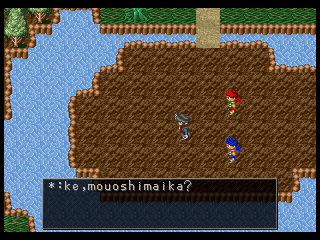
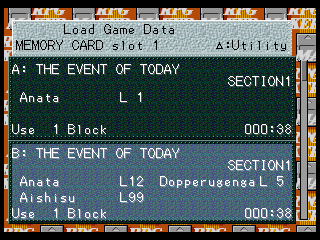
Three games made in RT3 are in the community's card archive: THE EVENT OF TODAY (a technique showcase), Be Instructive (a fighting game built from events) and Parody Quest 2 (a Dragon Quest III parody). Event techniques takes two of them apart.
The Tsukuru line#
RPG Tsukuru 3 sits in the middle of a line of console game makers. Its predecessor on the Super Famicom and its successor on the PlayStation have both been studied the same way as RPG Maker, in sister projects.
| RPG Tsukuru 2 | RPG Tsukuru 3 / RPG Maker | RPG Tsukuru 4 | |
|---|---|---|---|
| Machine and year | Super Famicom, January 1996 | PlayStation, 1997; the US release 2000 | PlayStation, 2000; Japan only |
| Publisher | ASCII (developed by Kuusou Kagaku) | ASCII; Agetec in the US | Enterbrain |
| Where games are kept | One 64 KB battery save on the cartridge; a Turbo File or a memory pack to carry a game | Memory cards: one System and any number of Scenarios, compressed | Memory cards; a better packer fits a System and 3–4 full Scenarios on a card |
| Database | 12 heroes, 127 items, 64 spells, 96 enemies; no jobs | 15 characters, 15 skills (RT3: jobs), 250 items, 230 magic, 250 monsters | 30 classes of 10 levels each, 64 capacities; 150 magic, 200 items |
| Events | Up to 4 pages an event; 40 commands; 240 switches, no variables | Up to 90 pages; 27 commands; 500 switches, no variables | Up to 30 pages; 103 codes; 512 switches and 256 variables, nested branches, timers |
| Battles | Front view, a fixed speed order, no misses or variance | Front view, the order re-rolled for every action, misses, ± 10 % damage, weighted monster patterns | Side view, real-time gauges, elements and weaknesses, summons, stealing |
| World map | Walked on, with land, sea and air vehicles and a Mode 7 view from the air | A map of towns and paths crossed with a cursor; the boat and the Blimp are items | Walked on again, with vehicles and a tilted 3D view |
| Text | One byte a character: kana and a small set of kanji; messages 14 × 4 | RT3: kana and JIS level-1 kanji, 18 a line. RPG Maker: English, 27 a line | 2,965 kanji, faces and name plates, 16 a line |
| Music | Its own driver, 30 songs; songs from the Super Famicom Kanadeeru, through a memory pack | 35 songs; RT3 adds songs from Kanadeeru 2 | 40 songs; songs from Music Tsukuru 3 |
| Graphics of your own | No drawing tool; a memory pack could add graphics (no such file survives) | Animetica / Anime Maker on the same disc | Character Tsukuru on a second disc |
| Sample game | だんきちのバクチンだいさくせん!!, a school comedy | ゴブリくんの冒険 / Gobli's Adventure | A sample game of its own |
Before: RPG Tsukuru 2#
RPG Tsukuru 2 RPGツクール2 came out on the Super Famicom in January 1996, published by ASCII and developed by Kuusou Kagaku 空想科学, whose logo movie still opens RPG Maker at boot. A development tag in its cartridge names the studio's system, and parts of its program go back to the studio's earlier Super Dante. So RT2, RT3 and RPG Maker are one team's line.
RT3 is a rebuild on the PlayStation, not a port, but it kept a great deal of RT2:
- Text: the one-byte text code. 139 of RT2's codes are identical in RT3, and the other characters keep their order, moved down to make room for Shift-JIS.
- Events: the shape of an event (pages tried from the highest down, each with its conditions), the interpreter's design, and every RT2 command but two. RT3 added Take Over, the party and stat commands, effects, the choice forms, the Game System switches and the scenario chain. It dropped RT2's mosaic and vanish commands, and stopped spending a separate command code on each direction.
- Movement: the same eight move types in RT2's order: Don't Move, Random, Right-Left, Up-Down, Close Up, Away, Step Only and Flashing.
- Maps: the split between the world map and the dungeons, and a ground layer with an object layer over it.
- Test Play: invincibility, encounters off and the switch editor; and a battle test beside the encounter editor.
- Battles: the front view, damage of attack minus defence halved, guarding halves, auto-battle. RT3 added chance at every step: misses, variance, criticals, weighted monster patterns.
It dropped what the Super Famicom's limits had shaped (packed save layouts, a script machine for the menus) and the walkable world map with its vehicles and Mode 7 flight: RT3's world map is a cursor between towns, and the boat and the airship became items (Field Edit). RT2's sample game, a school comedy, shares nothing with Gobli; its epilogue advertises RT3.
After: RPG Tsukuru 4#
RPG Tsukuru 4 RPGツクール4 came out in Japan in 2000, the year RPG Maker reached the US, from Enterbrain. It never had an English release: after RPG Maker, American players went straight to RPG Maker 2 on the PlayStation 2. It comes on two discs: the maker and player, and Character Tsukuru キャラクターツクール, a full graphics maker in place of Animetica. Songs come from Music Tsukuru 3, a separate disc, as RT3's came from Kanadeeru 2.
RT4 is the deeper game maker, built with less room:
- More: a side-view battle with real-time gauges and sprites that walk in and swing; 10 elements with weaknesses, summons, stealing and capture; 30 classes of 10 levels each; 256 variables, nested branches and timers in events; a walkable world map with vehicles and a tilted 3D view; weather and field effects; kanji with faces and name plates.
- Less: a Scenario holds 65,212 bytes against RPG Maker's 122,368, and its format spends far more on each command, so a full RT4 Scenario holds about a fifth of the text of a full RT3 one. Lower limits (150 magic, 200 items, 250 maps, 30 pages an event), at most 4 monsters a battle against 6, and imports read from the card at every use rather than loaded once.