Behind the scenes#
Who made RPG Maker, how it came to America, what its players made with it, and how this guide's facts were found. The program is a Japanese game maker in English; its makers' line runs back to the Super Famicom; its fans kept making games with it for twenty years; and the study behind this guide took it apart down to the byte and checked every finding against the running program.
The studio and the publishers#
RPG Maker is the US release of RPG Tsukuru 3 RPGツクール3, a 1997 PlayStation title from ASCII, the Japanese publisher of the Tsukuru series (Compared with RPG Tsukuru 3). Three companies show their logos when the disc starts:
- ASCII, the publisher of the Japanese original. Its old ASCII SOFT logo movie, a knight on a rearing horse, is on RPG Tsukuru 3's disc under the name the boot program asks for first, and still on the US disc as padding (The horse at boot).
- Kuusou Kagaku 空想科学, the developer, whose logo movie plays at every boot. The same studio made RPG Tsukuru 2 on the Super Famicom; its development tag is in that cartridge, and parts of its program go back to the studio's earlier Super Dante (The Tsukuru line).
- Agetec, the US publisher, which brought RPG Maker to North America in 2000 and wrote its English.
A fourth logo, Spline, "Creative Software Corporation", appears between Kuusou Kagaku's and Agetec's. The study's notes don't say what part Spline played.
The game's own ending credits name the rest. After a game's four staff lines, the roll shows RPG Tsukuru 3's staff at ASCII (a main director, a director, planners, eleven graphic designers, programmers, sound, package design and illustration, sales, publicity, the manual, a supervisor, special thanks and producers), then "RPG MAKER STAFF", the US team: a director, programmers, graphic design, a debug team from Pole To Win, Inc., special thanks, a product coordinator, producers and Agetec's localisation team (The ending).
The disc#
The disc is SLUS-00640. It holds three programs: a small boot program that shows the logos, a launcher that offers RPG Maker or Anime Maker, and the two of them, RPG3.EXE and ANIM.EXE, which still carry the Japanese original's names. Their data sits in three archives: the pictures (COMDATA.BIN), the code that loads when needed (OVERLAY.BIN, 25 sections) and the music and sound (SOUND0.BIN). How it works takes them apart.
The boot sequence#
The boot never varies. The boot program has no random numbers in it. It shows the ASCII logo as a still picture, plays Kuusou Kagaku's movie (270 frames, about 9 seconds, with sound), shows Spline's and Agetec's logos, and loads the launcher, about 2,400 frames, some 40 seconds, after power-on. From the eleventh frame of a logo, START, ×, ○, △ or □ skips straight to the launcher.
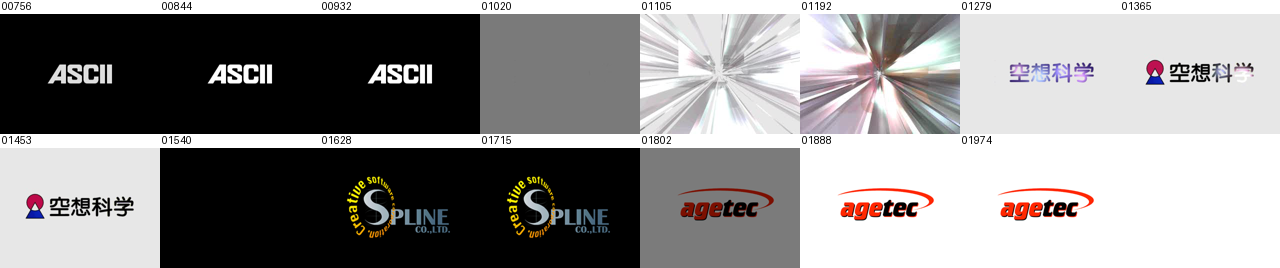
The boot table still names a movie called L_ASCII.STR first, which isn't on the US disc, so the US boot shows the ASCII still in its place. RPG Tsukuru 3's disc has that file: it is the ASCII SOFT horse. The US disc kept the same movie only as padding after Kuusou Kagaku's, and that is why a scratched disc can, once in a while, show a horse at boot and freeze (The horse at boot).
The localisation#
Agetec translated the program, not the engine. The game engine, the editors and the event commands are RPG Tsukuru 3's, and they make the same decisions: battles logged in the Japanese program replay without a difference through the US rules. What changed:
- The text. RPG Tsukuru 3 writes Japanese with a kanji font of 3,489 characters. The US program kept the code that draws it, switched it off, left the font out and added an English font of one byte a letter. A message line went from 18 characters to 27.
- The keyboard. The kana keyboard, with its kanji panel, became one grid of letters. The Japanese keyboard's backdrops are still in the US data, unused (The Japanese keyboard).
- The music. The 35 songs were renamed and 17 to 35 put in another order. The manual kept the Japanese order, so its song numbers are wrong (Corrections). The import of songs from Ongaku Tsukuru Kanadeeru 2 was cut (Leftovers of the song import).
- The names. The editors got English names, not always translations: the Japanese program's "job" became Skill, "hero" Main Characters.
- The sample game. ゴブリくんの冒険 became Gobli's Adventure. The translators rebuilt it in the editors themselves: the same 1,949 commands, its 408 messages written afresh, the monster names retyped (The sample game).
A handful of Japanese strings survived in places the translators didn't reach, and show as boxes, because the US program draws every Japanese character as one placeholder (Strings that were never translated).
The licence#
The US manual grants a royalty-free licence to make, use, sell, distribute and publish works made with RPG Maker or with its components, on two conditions: the work carries the RPG Maker logo on its media or packaging, and its maker tells the publisher about it by post Manual 1 p. 69. According to the notes, an Agetec representative later said that games may be passed on together with the stock graphics and music. The program itself remains copyrighted.
The community and its games#
People went on making games with RPG Maker long after it came out (the archive includes games from the 2010s) and passed them around as memory-card saves: DexDrive files copied from real cards, PlayStation 3 saves and raw card images. Many were never finished; some fill every byte the program allows. Their makers are not named here.
The card archive#
The study worked from a community preservation archive of about 180 fan games: 112 folders of full games, 69 of demos, and three games made in the Japanese RPG Tsukuru 3. They come as 572 card images in three formats (409 DexDrive .gme, 142 PS3 .psv, 21 raw .mcr).
| Save | In the archive | Read cleanly | Different contents |
|---|---|---|---|
| System Data | 198 | 197 | 167 |
| Scenario Data | 359 | 359 | 281 |
| Player saves | 14 | 14 | 14 |
| Test Play saves | 15 | 15 | 14 |
| Deleted saves still on the cards | 154 | 112 | 85 found nowhere else |
Every save but one reads cleanly: its data unpacks to the declared size and its checksum matches. The exception, Reigning Heart's System save, has a wrong link in the card's directory; read the right way, its data is intact. The archive was only read, never changed.
Deleted saves are often still there. A card marks a deleted save's blocks free but leaves the data until something overwrites it. Of 154 deleted RPG Maker saves on the archive's cards, 112 still read cleanly, and 85 hold contents found nowhere else in the archive. Some are systems and scenarios of projects with no live save anywhere: The War of Magic, RIVALS, Reverence: SotK, Sententia, Suppress, Pav SE, and The Quest, a scenario of some other project left on a card of Robo Challenge's.
Every event in the archive reads: across 271 different scenarios and 172 Systems, 13,278 maps and 154,033 events, all 315,111 event pages parse to their exact length. The one layout error the archive found in the study's own reading (the map index has 991 entries, not 992) was fixed, and the problems that remain are things the editor lets a maker leave behind: moves to maps that were deleted, magic that was removed after a character learned it.
By kind#
- Full games in many chapters, on as many cards: a System and a dozen or more scenarios joined by Next Scenario.
- Demos and unfinished games: a few maps, a first chapter, a test of an idea.
- Joke games and parodies, from a game made among friends to a parody of a famous console RPG.
- Technique showcases, which do with events what the program was never meant to do: a battle system of their own, a fighting game, a piano.
- Games split across two Systems, a trick for games too big for one: save, reset, swap the card and Continue.
- Japanese games made in RPG Tsukuru 3, readable in RPG Maker once converted (Converting games).
By title#
The games the study looked at closely:
| Game | Kind | What the study took from it | In this guide |
|---|---|---|---|
| Arc Arath | A full RPG on 19 cards: one System and 18 scenarios | The example game for everything: every rule checked against it, its whole story played through in the emulator | throughout; A piano from switches |
| Secret of Everyone | A joke RPG, one scenario, complete | Arc Arath's beginnings | Before Arc Arath |
| Generic Quest VIII | A short joke RPG and a demonstration | A whole battle system written in events, with HP bars, spells, elements and an enemy AI | A battle system from items |
| THE EVENT OF TODAY | An RPG Tsukuru 3 game: a showcase of event techniques | Release detection from overlapping events, Gold as a register, item staircases; 13 imported songs | Staircases, Gold and release detection |
| Be Instructive | An RPG Tsukuru 3 fighting game built from events | A parser for fighting-game command inputs | A combo parser |
| Parody Quest 2 | An RPG Tsukuru 3 parody of Dragon Quest III | A job system with mastery counters kept in switches | RPG Tsukuru 3 |
| Way of Peace, Binding Souls, Treasure Hunters, Dynasty Project IV, Abyss of Vinsaga | Games shipped with two System saves | Three of them outgrew one System and split the game: save, reset, swap the card, Continue | Two Systems for one game |
| Reigning Heart | A full game | The one damaged save in the archive: a broken link on the card, the data itself intact | Keeping saves safe |
Arc Arath, the example game#
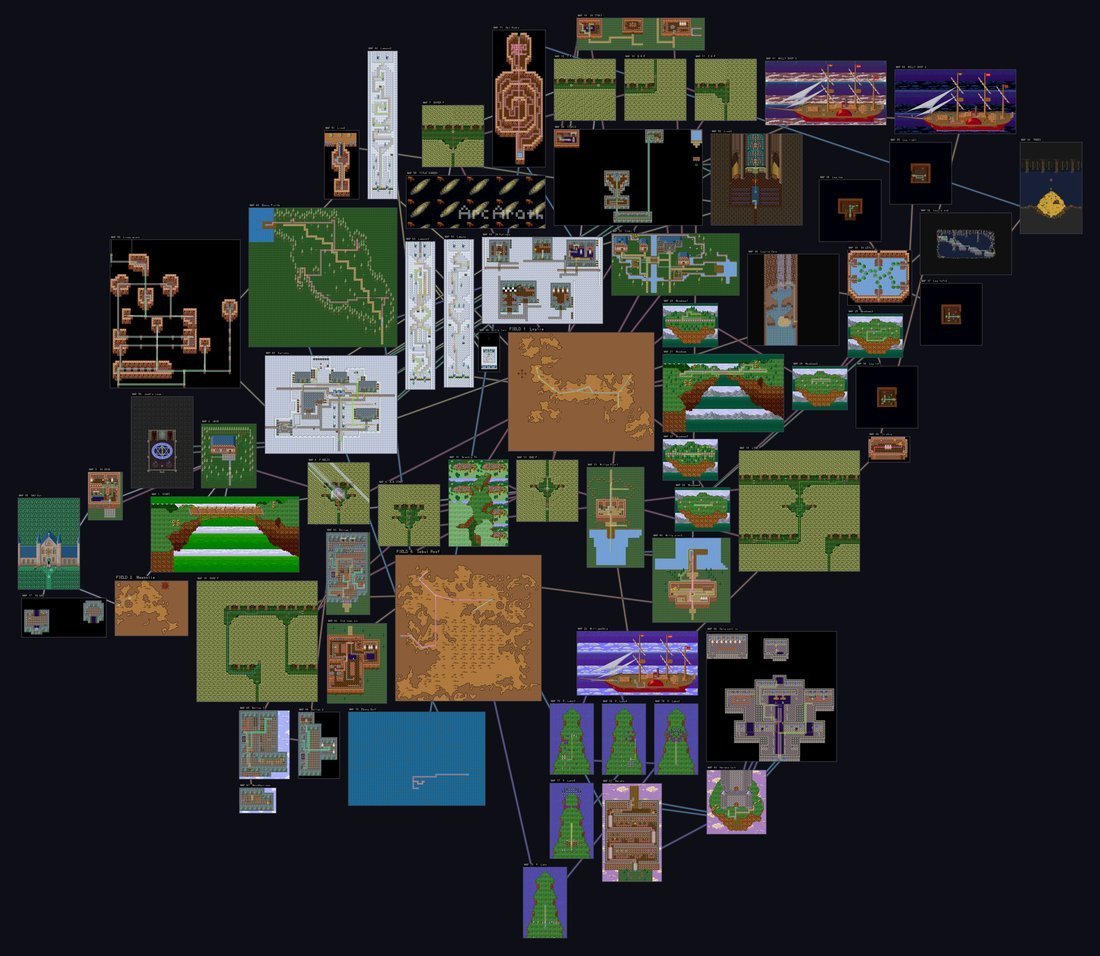
Arc Arath is the game this guide uses as its example throughout. It is a complete RPG on 19 memory cards: one System and 18 scenarios, an intro and 17 chapters, each filling its own card. Its System has 210 bytes free of 122,368; its maps take more than two thirds of that, 88 drawn by hand and 155 taken from the disc's ready-made maps; and in the chapters measured 86 % of the bytes are dialogue, about 19,000 words a chapter. It was finished in the 2010s and patched at least once. Its creators' archived web site, with a long FAQ and walkthrough, served the study as a check on what the game should do.
Before Arc Arath: Secret of Everyone#
Arc Arath began as a joke. Its creator first made a game alone while learning RPG Maker: Secret of Everyone, a modern-day comedy in one scenario about four friends whose weekly pizza night goes wrong when one of them doesn't turn up. It is complete, with an ending, a Battle Arena that pays out in pizzas, a talking chicken in the party, and items such as a Cell Phone, a Penguin Suit and a Large Pizza. A friend played it and asked what it would be like as a real game.
The answer came in three stages: the original; Secret Of Everyone, remastered, a demo made by three college students with imported graphics and a custom title; and Arc Arath, at first called Secret of Everyone too, renamed when its story grew less comic and became its own world rather than a parody of Secret of Evermore. The full game keeps a good deal of the joke one: monsters, places, spells and items by the same names, and the joke about people turned into chickens. The original's two cards, never published, read cleanly: 144 maps, 1,393 events, 2,020 pages.
How this study was done#
Every rule in this guide was read from the program's code and then checked against the running program. The guide was written from the notes of that study; where the notes don't settle something, the guide says nothing.
- The code. The programs were loaded into Ghidra, a disassembler and decompiler, with every overlay section at its load address: RPG Maker's
RPG3.EXE, Anime Maker'sANIM.EXE, and RPG Tsukuru 3'sRPG3.EXEbeside them. Functions were named as each subsystem was understood, and the Japanese program's were matched to the US ones by the order of their calls. - The emulator. PCSX-Redux, an open-source PlayStation emulator with a scripting interface, was driven by scripts: pressing buttons, stopping on a given instruction, and copying the screen, the main memory and the video memory at the moment a frame is drawn. A build patched to skip the console's idle waits ran it many times faster, and runs were checked to give the same memory as the unpatched one.
- The models. For each part of the program, a small model was written from the notes: the renderer, the text, the fades, each editor's screens and writes, the battle engine, the sound driver. A model passes only when its output equals the console's: every pixel of a screen, every byte of a save, every decision of a battle, every write to the sound chip. Every screenshot in this guide is either a capture from the emulator or a picture drawn by such a model and checked against one.
- The data. The models were run over the community's card archive and over Arc Arath, so that no rule rests on one game's habits.
- The whole game. Finally Arc Arath was played from beginning to end in the emulator, by a bot, and the project's model of the game replayed the same presses.
- The regression run. Over 200 of these checks are kept and re-run after every change, in a minute or two, so a later finding can't quietly break an earlier one.
| What | How it was checked | Result |
|---|---|---|
| Editors | Every screen of the 14 editors and the MEMORY CARD pages captured in the emulator and drawn by a model from the same memory | 1,666 captures, all equal pixel for pixel |
| Editor writes | Each editor driven in the emulator, and the bytes it wrote compared with a model's | every case equal: Event Edit 160, Dungeon Edit 205 + 36, Field Edit 103 + 37, the database editors 2,419, the settings editors 640, Monster Appearance 267, MEMORY CARD 413 |
| Anime Maker | Every editor, pop-up and transition captured; its writes checked the same way | 346 screens exact; 1,705 checks over 125 cases |
| Battles | Battles logged with every random number, then replayed through a model of the battle engine | 1,362 decisions in 9 battles, no mismatch; and 2,082 more from RPG Tsukuru 3 |
| Battle screens | Battle frames drawn by a model from memory | 1,131 of 1,170 exact; the other 39 differ only where a number had been changed by hand |
| Sound | Every write to the sound chip logged while songs and effects play, and replayed through a model of the sound driver | 265,936 writes, no mismatch |
| Field and world map | Live frames captured with the memory behind them, and drawn by models | 31 field frames, 97 world-map frames, all 12 event effects (68 frames), 41 credit pages and 57 ending snapshots exact; 72 of 76 fade frames exact, the other 4 differing only under a message window |
| Palette cycling | Every rotation of the animated water, lava and lights logged and replayed | 30,770 rotations, no mismatch |
| Saves | The saves of the fan archive and of the project's own runs read, rebuilt and written back | 462 System and Scenario saves, 99 player saves and 773 Anime Maker saves rebuilt byte for byte; 1,632 saves written back to their cards exactly |
| Events | Every event page in the fan archive parsed | 315,111 pages in 271 scenarios, every one to its exact length |
| A whole game | Arc Arath played from the intro to its best ending in the emulator, and the same button presses fed to the project's own model of the game | 4,900,820 frames, equal on every one |
The manuals were read against all of this. Where they disagree with the program, the program wins: Where the manual is wrong. RPG Tsukuru 3 was run and checked the same way (Compared with RPG Tsukuru 3), and so, in sister studies, were RPG Tsukuru 2 and RPG Tsukuru 4.