RPG Maker, explained#
RPG Maker is a PlayStation disc for making role-playing games without programming. It is the American release of ASCII's RPG Tsukuru 3 (RPGツクール3), translated by Agetec (SLUS-00640). You build a game from a database, maps and events, save it to a memory card, and play it on the same disc. This guide explains how to make a game with it and how to play one, and how the program works inside.
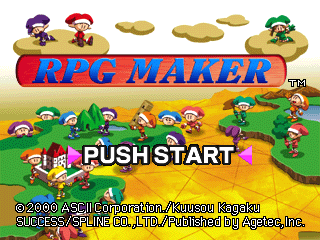
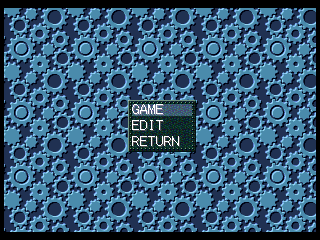
You make a game in a dozen editors: the heroes, their spells, items and skills, up to 250 monsters and where they appear, up to 990 dungeon maps and eight world maps, and the events that tell the story. Nothing of yours is kept on the disc. The game lives on memory cards: one System Data file holds the database and every map, and one or more Scenario Data files hold the events. Anyone with the disc and the card can play it from the GAME menu, which is how RPG Maker games came to be swapped on cards, and later as card images. Memory cards and saves shows how the files fit together.
The program's own menus are in English throughout. A few of the screens' names differ from the manual's, and the guide always uses the screen's.
The disc and its programs#
The disc holds three programs, and one launcher that chooses between them.
| Program | What it does |
|---|---|
| The boot program | Shows the ASCII screen, the opening movie and the logos, then PUSH START. |
| The launcher | The menu after PUSH START: it starts RPG Maker or Anime Maker, and both come back to it. |
| RPG Maker | The game maker itself: GAME to play a game, EDIT to make one. Nearly all of this guide is about it. |
| Anime Maker | A drawing and animation program. Its characters, title pictures and monsters can be imported into a game. |
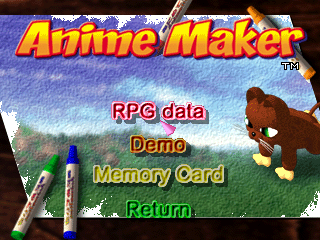
Anime Maker (called Animetica in Japan) has its own editors for drawing frames, animating characters and telling short stories with them. What it saves to a card, RPG Maker can bring into a game: walking characters, title backgrounds and monster pictures. It is covered in Anime Maker.
The disc also carries a sample game, Gobli's Adventure, about a goblin who wants to be a boss. GAME → Sample plays it, and EDIT → Load Sample opens it in the editors to see how it was made (Getting started).
How this guide was made#
The guide comes out of a preservation project that took the program apart. Every rule in it was read from the program's code and then checked against the running game, in the PCSX-Redux emulator: battles replayed decision by decision, editor screens compared pixel for pixel, and saves written by the project's tools and loaded back by the game. Where the notes don't settle something, the guide leaves it out rather than guess. Behind the scenes tells how the study was done, and How it works gives the internals.
Every screenshot is a real PlayStation screen: a capture from PCSX-Redux, or a picture drawn by the project's model of a screen and checked pixel for pixel against the emulator. None is a mock-up. The graphics and sounds in the catalogue and on Music and sound are drawn and played from the disc's own data.
The two manuals that came in the box are cited by their printed page numbers, as Manual 1 p. 17 for Manual 1 (System Data) and Manual 2 p. 6 for Manual 2 (Anime Maker and Scenario Mode). The guide is its own text, not a copy of theirs. The manuals are wrong in places; the guide gives the program's answer and says so in a box. Where the manual is wrong gathers them all.
The boxes#
Six kinds of box stand beside the text:
The pictures and sounds#
Screens are shown at twice their size with their pixels kept sharp. Some carry numbered boxes, explained in a legend under the picture. Animations play by themselves; sound clips have a player. The example game in many pictures is Arc Arath, a full-length fan game made in RPG Maker, which the project played from start to finish in the emulator. Its makers are not named anywhere in the guide, and no picture shows them.
The chapters#
Start here#
Making a game#
Resources#
Reference#
What you need#
The disc and a memory card: without one you can make a game but not keep it. A whole game with its database, maps and one scenario takes from a few blocks to most of a card's 15, so a second card helps. A PlayStation controller is enough (Anime Maker also takes a PlayStation Mouse). Every screen here is from the US disc, SLUS-00640.